


Infinity Series
Showing all 7 results
-
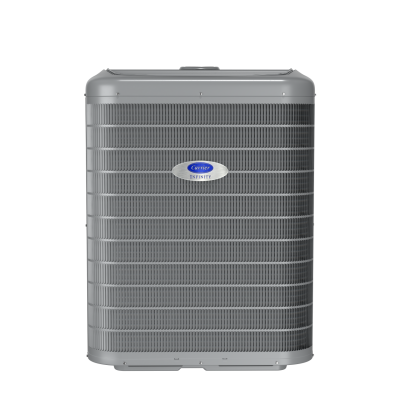
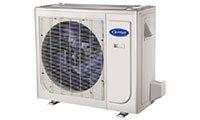
Carrier Infinity 21 Variable-Speed Central Air Conditioners 26VNA1
-
 Discontinued
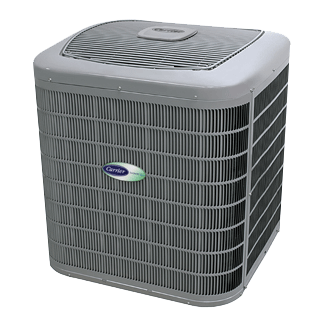
Carrier Infinity 17 Central Air Conditioners 24ANB7
-
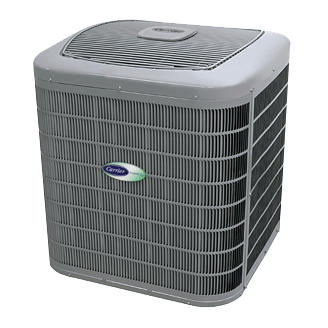 Discontinued
Carrier Infinity 17 Coastal Air Conditioners 24ANB7**C
-
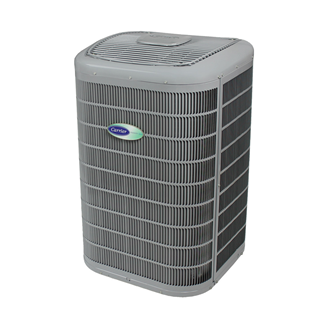 Discontinued
Carrier Infinity 19VS Central Air Conditioners 24VNA9
-
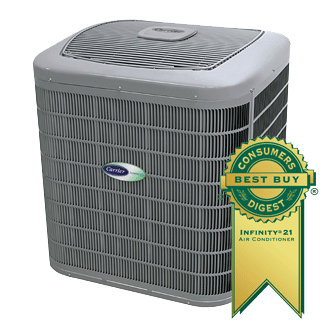 Discontinued
Carrier Infinity 21 Central Air Conditioners 24ANB1
-
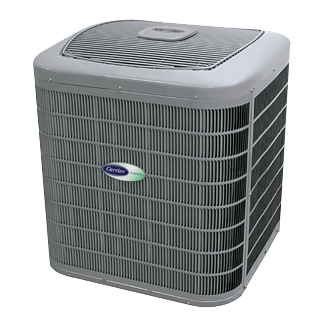 Discontinued
Carrier Infinity® 16 Central Air Conditioner 24ANB6
-
 Discontinued
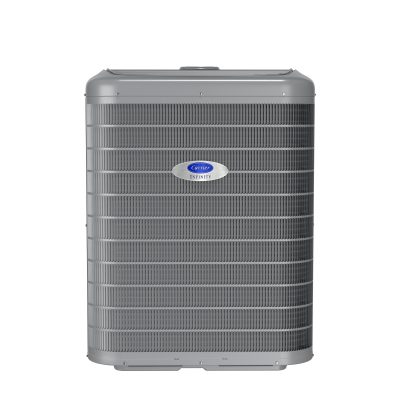
Carrier-Infinity 26 Air Conditioner with Greenspeed Intelligence 24VNA6
Infinity Air Conditioners for Toronto and the GTA
Infinity air conditioners are premium central cooling systems built around variable-capacity operation, advanced controls, high seasonal efficiency, and precise humidity management. They are intended for homeowners who value quieter operation and steadier indoor temperatures more than the lower initial cost of single-stage or two-stage equipment.
When an Infinity Air Conditioner Is the Right Choice
The category is best suited to homes where comfort expectations extend beyond simply reaching the thermostat setting. The following factors help determine whether variable-capacity cooling will provide enough practical value to justify the higher equipment and installation cost.
Temperature Consistency
Variable-capacity output adjusts as cooling demand changes, reducing the noticeable indoor temperature swings associated with full-output cycling. This matters most in homes where rooms regularly feel too warm or too cold between cycles.
Humidity Management
Longer operation at reduced capacity can remove more indoor moisture than short, aggressive cooling cycles. This can improve comfort during humid Toronto and GTA summer conditions.
Premium System Integration
The strongest performance requires compatible indoor equipment, communicating controls, and correct airflow setup. Installing only the outdoor unit may limit the features that distinguish this category from simpler alternatives.
How Variable-Capacity Cooling Works
An Infinity air conditioner can adjust compressor output across a broad operating range instead of running only at full capacity. During moderate weather, it can operate at a reduced level to maintain the set temperature with fewer starts and stops.
On hotter days, the system increases output as required. This provides more precise cooling than a single-stage system and more adjustment capability than equipment limited to two operating stages.
Infinity vs Other Central Air Conditioner Categories
The correct category depends on whether the homeowner prioritizes initial cost, balanced performance, or maximum comfort control. This comparison shows the real-world trade-offs between common central cooling configurations.
Cooling Efficiency and Operating Cost
Infinity models occupy the high-efficiency end of central air conditioning. Variable operation reduces unnecessary full-capacity runtime and allows the system to respond more closely to the home’s actual cooling load.
Higher efficiency does not guarantee lower electricity use on its own. Incorrect sizing, duct leakage, restrictive airflow, improper refrigerant charging, incompatible indoor equipment, and aggressive thermostat settings can prevent the system from achieving its expected performance.
Humidity Control During Toronto Summers
Humidity control is one of the strongest reasons to consider this category. Running for longer periods at lower capacity allows the evaporator coil to continue removing moisture while avoiding the rapid temperature drop that can end a single-stage cycle too early.
Variable-capacity cooling can improve normal seasonal humidity, but it cannot solve every moisture problem. Basement water entry, inadequate ventilation, air leakage, oversized equipment, and building-envelope issues may require separate correction.
Sound Performance and Outdoor Placement
Reduced-capacity operation can make Infinity equipment substantially quieter during normal cooling conditions than systems that start repeatedly at full output. This can be valuable when the outdoor unit must sit near a bedroom, patio, neighbour, or narrow side yard.
Sound performance still depends on installation location, unit clearances, mounting surface, surrounding walls, and refrigerant-line vibration. Premium equipment placed in an acoustically confined area may still be more noticeable than expected.
Infinity System Controls and Compatibility
The complete system can coordinate cooling output, indoor blower operation, humidity, ventilation, indoor air quality equipment, and zoning. This level of integration provides more precise control than a conventional thermostat simply switching equipment on and off.
The trade-off is that equipment compatibility becomes more important. The outdoor unit, indoor coil, furnace or air handler, blower, control, and any zoning components should be selected as one system rather than as independent products.
Air Conditioner Sizing for Variable-Capacity Performance
Variable-capacity operation provides greater flexibility, but it does not eliminate the need for an accurate cooling-load calculation. Sizing should account for insulation, windows, air leakage, orientation, occupancy, floor layout, and internal heat sources.
Oversizing can reduce low-capacity runtime and limit the humidity and temperature benefits that justified the premium system. Undersizing can leave the equipment operating near maximum output for extended periods during peak summer conditions.
Why Oversizing Still Creates Problems
Variable-capacity equipment can adapt to changing demand more effectively than fixed-output systems, but its operating range is not unlimited. Selecting excessive capacity can still compromise comfort and efficiency.
Premium Equipment with the Wrong Capacity
An oversized Infinity air conditioner may satisfy the thermostat too quickly to maintain long, stable low-capacity cycles. The homeowner may pay for premium modulation while still experiencing short runtime, uneven rooms, excess humidity, and unnecessary equipment wear.
Indoor Coil and Blower Requirements
The indoor evaporator coil must be approved for the selected outdoor unit and sized for the required cooling capacity. The indoor blower must also adjust airflow correctly as compressor output changes.
Keeping an older coil or furnace may lower the immediate replacement cost, but it can restrict variable operation, reduce certified efficiency, and limit humidity control. Existing indoor equipment should be evaluated before selecting the outdoor model.
Ductwork and Airflow Evaluation
Premium variable-capacity equipment cannot overcome an inadequate duct system. Undersized returns, restrictive filters, closed registers, damaged ducts, and high static pressure can reduce airflow and prevent consistent cooling.
Airflow should be tested at different operating levels because the system must perform correctly at both low and high capacity. Duct modifications may be necessary when existing distribution problems have caused persistent hot rooms, excessive vent noise, or weak return airflow.
Infinity Air Conditioner Installation
Installation should include a load calculation, approved equipment matching, refrigerant-line assessment, electrical review, condensate-drain inspection, airflow testing, control configuration, and complete system commissioning.
Communicating systems require more detailed setup than basic air conditioners. If controls, blower profiles, humidity settings, or equipment communication are configured incorrectly, the system may not deliver its expected comfort and efficiency.
Infinity Air Conditioner Replacement
Replacement may be appropriate when an existing air conditioner has major compressor problems, repeated repair needs, poor humidity control, high electricity use, excessive sound, or difficulty maintaining consistent temperatures.
Replacing only the outdoor unit may not be the best approach when the indoor coil, blower, furnace, or controls are outdated or incompatible. A complete-system replacement costs more initially but may be necessary to access the category’s full performance.
Infinity Air Conditioner Cost Factors
Installed cost depends on cooling capacity, indoor coil selection, furnace or air-handler compatibility, communicating controls, zoning, refrigerant piping, electrical work, drainage, duct modifications, equipment access, and commissioning requirements.
Quotes should be compared by complete installation scope rather than the outdoor-unit price alone. A lower proposal may omit indoor equipment upgrades, control components, duct corrections, electrical changes, or detailed startup procedures.
Infinity Air Conditioner vs a Heat Pump
An Infinity air conditioner provides premium cooling while relying on a separate heating system during winter. A heat pump can provide both cooling and electric heating, which may support electrification or dual-fuel goals.
The air conditioner may be the more direct choice when the home already has a suitable furnace and the project is focused on cooling performance. A heat pump deserves consideration when winter operation, gas reduction, available incentives, and long-term heating strategy are also priorities.
When a Lower-Tier System May Be More Practical
Infinity equipment may not provide a strong return when the household mainly wants basic cooling, plans to move soon, uses the air conditioner infrequently, or has a limited installation budget. A correctly sized single-stage or two-stage system may meet those needs at a lower cost.
Premium equipment is also difficult to justify when major duct or building-envelope problems remain unresolved. Correcting airflow, insulation, air leakage, or solar heat gain may improve comfort more than upgrading the outdoor unit alone.
How to Choose an Infinity Air Conditioner
System selection should begin with the home’s cooling needs and the homeowner’s comfort priorities, not simply the highest available efficiency rating. Use this checklist to evaluate whether the complete installation can support premium variable-capacity performance.
Infinity Air Conditioner Selection Checklist
- Complete a cooling-load calculation before selecting equipment capacity.
- Confirm that variable-capacity operation provides meaningful value for the home’s humidity, sound, and temperature-control needs.
- Verify approved matching between the outdoor unit, indoor coil, furnace or air handler, blower, and control.
- Review duct sizing, return-air capacity, filtration, static pressure, and room-to-room airflow.
- Inspect refrigerant lines, electrical service, condensate drainage, outdoor clearances, and equipment placement.
- Determine whether communicating controls, zoning, ventilation, or indoor air quality integration will be included.
- Compare complete installed scope, efficiency, warranty, commissioning, and expected ownership period.
- Evaluate whether an air conditioner or heat pump better supports the home’s long-term HVAC plan.
Local Suitability for Toronto and the GTA
Infinity air conditioners are well suited to Toronto and GTA homes where humid summer conditions, temperature variation, outdoor-unit sound, or advanced zoning make refined cooling valuable. They may be particularly useful in larger homes, multi-level layouts, premium renovations, and properties where consistent comfort is a priority.
The category is less compelling when the existing ductwork cannot support the required airflow or when basic cooling at the lowest installed cost is the main goal. The system should be selected only after evaluating the complete home and HVAC configuration.
Plan Your Infinity Air Conditioner Installation
An Infinity air conditioner can deliver efficient, quiet, and precise cooling when the capacity, indoor coil, blower, controls, refrigerant circuit, and ductwork operate as a coordinated system. Professional system design and commissioning are essential to receiving the comfort advantages associated with this category.
FREE In-Home Estimate