


Indirect Tanks
Showing all 2 results
Indirect Tanks for Boiler-Fed Domestic Hot Water
Indirect Tanks are insulated domestic hot-water storage tanks that use heat supplied by a boiler or another compatible hydronic heat source rather than a burner inside the tank. This category includes compact boiler-integrated storage and larger dual-coil tanks, so the right choice depends on hot-water demand, available boiler capacity, mechanical-room space and whether a second heat source is part of the system design.
For Toronto and GTA homes, tank capacity alone does not determine hot-water performance. Boiler output, heat-exchanger capacity, stored-water volume, recovery rate and simultaneous fixture demand need to be considered together.
Indirect Tank Options in This Category
The products in this category address different applications rather than simply offering small and large versions of the same tank. Compact storage is suited to specific boiler-integrated installations, while dual-coil storage provides substantially more capacity and flexibility for systems designed around multiple heat sources.
Modulo Indirect Storage Tank
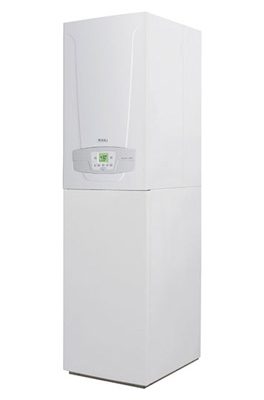
The Modulo combines a compact 21-gallon stainless-steel storage tank with a configuration designed to work beneath compatible wall-mounted boiler equipment. Its smaller footprint makes it different from a conventional large indirect cylinder.
Its relatively small stored volume means performance depends heavily on the boiler's ability to recover hot water quickly. This makes boiler compatibility and output more important than simply comparing the 21-gallon capacity with a larger conventional storage tank.
Dual-Coil Indirect Storage Tanks
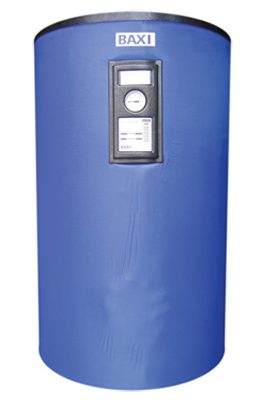
Dual-coil tanks use two separate internal heat exchangers, allowing heat to be transferred into the domestic water from different sources. In a two-source arrangement, one coil can receive heat from a primary renewable or hydronic source while the other provides reheating from a boiler.
The two coils can also be configured together for an appropriate single-source application. This flexibility makes a dual-coil tank useful when the mechanical design requires more than conventional single-coil boiler storage, but the additional complexity offers little benefit when only a simple boiler-fed indirect tank is required.
Dual-Coil Tank Capacities
Available storage capacities span a wide range, allowing the system to be selected for residential hot-water demand as well as much larger applications. Moving to a larger tank increases stored hot-water reserve, but it also requires more mechanical-room space and does not compensate for inadequate boiler or heat-exchanger capacity.
How to Size an Indirect Tank
Indirect water heater sizing should consider peak domestic hot-water demand and how quickly the connected boiler can replace heat removed from the tank. A smaller tank with strong boiler recovery can perform differently from a larger tank connected to a heat source with limited available output.
Peak Hot-Water Demand
Estimate simultaneous showers, baths and other major draws. Tank selection should cover realistic peak use rather than household size alone.
Boiler Output
The boiler must supply enough usable capacity to the indirect circuit for the expected recovery performance.
Storage Volume
More stored water increases reserve capacity, but unnecessarily large storage increases footprint and stored-water heat loss.
Heat Exchanger Capacity
The internal coil must transfer boiler energy effectively; a large boiler cannot deliver its full potential if heat transfer is the limiting factor.
Boiler Priority Control
Domestic-hot-water priority can direct boiler capacity to the tank during a call, improving recovery but temporarily reducing space-heating output.
Mechanical-Room Space
Tank diameter, height, piping clearances and replacement access can rule out a capacity that otherwise appears suitable on paper.
Storage Capacity vs Recovery Rate
Storage capacity tells you how much heated water can be held, while recovery describes how quickly the system can restore tank temperature after hot water is used. Both affect whether a household runs out of hot water during consecutive or simultaneous demands.
Increasing tank size creates a larger reserve, but it is not always the best solution. If the connected boiler or heat exchanger cannot recover the tank at the required rate, a larger tank may simply take longer to reheat after a major draw.
Why Boiler Capacity Matters
An indirect tank does not create its own heat, so domestic-hot-water performance is tied to the connected boiler. Published tank performance can depend on boiler-side water temperature, flow and available input to the heat exchanger.
A replacement tank should therefore not be selected from storage capacity alone. If a tank is capable of accepting more boiler input than the existing boiler can provide, actual recovery will be lower than the tank's maximum potential.
Selecting a Tank From Its Maximum Recovery Rating
A homeowner may choose an indirect tank expecting its highest published recovery performance even though the existing boiler cannot supply the required heat input. The tank will still heat water, but actual recovery can be substantially lower than expected and peak hot-water demand may not be satisfied.
Domestic Hot-Water Priority
Indirect tank systems can be controlled so domestic hot water receives priority when tank temperature falls. During a priority call, boiler output is directed toward reheating the tank before normal space-heating operation resumes.
This strategy can support fast recovery without permanently oversizing the boiler for simultaneous maximum space-heating and domestic-hot-water loads. Priority duration and system design still need to account for the building's heating requirements during cold Toronto weather.
Indirect Tank Performance During Toronto Winters
Incoming municipal water is colder during the heating season, increasing the temperature rise required to produce usable domestic hot water. This can reduce the amount of mixed hot water available from a given storage volume compared with warmer inlet-water conditions.
Winter sizing should therefore consider realistic cold-water temperature and peak fixture demand. A tank that performs comfortably during summer conditions may have less effective capacity when Toronto inlet water is much colder.
Indirect Tank vs Combi Boiler Hot Water
An indirect tank stores heated domestic water, while a combi boiler normally produces domestic hot water as it is required without a separate large storage tank. The better configuration depends on peak demand, available space, boiler capacity and the number of simultaneous fixtures.
Indirect Tank vs Standalone Gas Water Heater
A standalone gas water heater has its own burner and fuel connection, while an indirect tank uses the boiler as its heat source. In a home that already has a suitable hydronic boiler, an indirect tank can avoid adding another combustion appliance.
The trade-off is dependence on the boiler. If the boiler is near the end of its service life, replacing the domestic water-heating system without considering the future boiler plan can create unnecessary rework.
Indirect Tank vs Electric Storage Water Heater
An electric storage tank operates independently of the boiler and can simplify domestic water heating where suitable electrical capacity is available. An indirect tank instead uses boiler energy and integrates domestic hot water with the hydronic system.
For an existing boiler-heated Toronto home, the decision should compare total system performance and installation requirements. Moving to electric storage can reduce dependence on the boiler for summer hot water, while an indirect system can provide strong recovery when paired with an appropriately sized boiler.
Single-Coil vs Dual-Coil Indirect Tanks
A conventional single-coil indirect tank normally uses one boiler-water heat exchanger. A dual-coil tank provides two separate heat-exchange circuits, creating options for a second heat source or a specialized system configuration.
Dual-coil construction should be selected for a reason rather than assumed to be an automatic upgrade. If the system will only ever use one conventional boiler circuit, a simpler single-coil replacement may be more practical when compatible equipment is available.
When a Dual-Coil Tank Makes Sense
Dual-coil storage is particularly relevant when a second heat source is planned or already installed. The lower and upper heat exchangers can perform different heating roles, allowing stored domestic water to receive heat from more than one circuit.
This arrangement also creates more design and control requirements. Pumping, sensors and temperature control must coordinate the available heat sources so the added coil provides a functional benefit rather than unused complexity.
Tank Insulation and Standby Heat Loss
Once domestic water reaches its target temperature, insulation slows heat loss from the stored water. The dual-coil tanks in this category use insulated construction, with thicker insulation used on the larger-capacity models.
Standby performance matters more as storage volume increases. Selecting a much larger tank than the building needs can increase the amount of water kept hot without improving actual peak-demand performance enough to justify the additional storage.
Indirect Tank Installation
Indirect tank installation requires coordination with the boiler, domestic-water piping and hydronic controls. The installation needs appropriate boiler-side circulation, domestic connections, temperature control, expansion provisions, pressure protection and service access.
A tank should not be treated as an isolated plumbing appliance. Poor boiler-side flow or incorrect control logic can reduce recovery even when the tank itself is correctly sized.
Boiler-Side Flow and Pump Selection
The indirect heat exchanger needs sufficient boiler-water flow to transfer energy into the stored domestic water. Pump selection and piping resistance therefore influence actual recovery performance.
Increasing boiler capacity does not automatically solve a flow limitation. If the indirect circuit cannot move the required water through the heat exchanger, available boiler output cannot be transferred effectively into the tank.
Indirect Tank Replacement
Replacing an indirect water heater is an opportunity to reassess both storage capacity and the connected boiler. Matching the old tank gallon-for-gallon can be reasonable when previous hot-water performance was satisfactory, but it should not replace a review of current household demand and boiler capability.
If the boiler will also be replaced soon, the two decisions should be coordinated. The new tank's heat exchanger, controls and desired recovery performance should match the planned boiler rather than being selected only around equipment that is nearing replacement.
Replacing a Baxi Modulo Storage Tank
The compact Modulo storage arrangement was designed around specific compatible boiler configurations and space-saving installation. Replacement therefore requires more than finding another tank with approximately the same storage volume.
Current replacement planning should verify piping, controls, available mechanical-room space, boiler condition and desired hot-water performance. A different indirect tank configuration may require changes to the original integrated arrangement.
Replacing an Existing Dual-Coil Tank
An existing dual-coil tank should not automatically be replaced with another dual-coil model. First determine whether both coils are actually used and whether a second heat source remains part of the home's long-term plan.
If only the boiler has ever heated the tank, a replacement can be evaluated around actual domestic-hot-water requirements rather than preserving unused system complexity. If two heat sources are active, coil arrangement and controls become essential replacement criteria.
Replacing a 50-Gallon Tank With a Smaller Tank
A smaller indirect tank may work well when household demand is modest and the boiler provides strong recovery, but reducing storage without calculating peak demand can cause hot-water shortages during consecutive showers or simultaneous fixture use. The replacement decision needs both storage and recovery calculations.
Indirect Tank Installation Cost
Indirect tank cost depends on storage capacity, heat-exchanger configuration, tank construction, boiler-side piping, circulator requirements, controls, domestic-water piping, expansion provisions, removal of the old tank and mechanical-room accessibility.
Replacement cost can be lower when existing piping and controls are compatible, but choosing a different tank configuration can increase installation scope. Equipment price alone does not show the cost of integrating the tank correctly with the boiler.
Choosing an Indirect Tank for Toronto and the GTA
The strongest indirect tank selection balances domestic-hot-water demand with boiler capacity and available storage rather than simply choosing the largest tank that fits. Compact storage can work well with fast recovery, while larger tanks provide more reserve for periods of heavy simultaneous use.
Toronto and GTA households should also consider colder winter inlet water, existing boiler condition, mechanical-room dimensions and future heating-system plans. These factors determine whether compact boiler-integrated storage, a larger indirect tank or a dual-coil configuration provides the better long-term fit.
Indirect Tank Selection Checklist
Before choosing or replacing an indirect tank, confirm how the complete boiler and domestic-hot-water system will operate during peak demand. The following checks help prevent oversizing storage or expecting recovery that the connected boiler cannot provide.
Choose the Right Indirect Tank
- Estimate peak domestic-hot-water demand, including simultaneous showers and other major fixtures.
- Determine the storage volume needed rather than matching the existing tank automatically.
- Verify available boiler output for domestic-hot-water recovery.
- Compare heat-exchanger requirements with the boiler's actual available capacity.
- Account for colder Toronto inlet water when evaluating winter hot-water performance.
- Confirm whether domestic-hot-water priority will be used.
- Verify boiler-side flow and circulator requirements.
- Choose dual-coil storage only when the additional heat-exchanger configuration serves a defined purpose.
- Check tank diameter, height and service clearances before ordering.
- Plan domestic expansion and pressure protection as part of the installation.
- Evaluate the remaining service life of the existing boiler before selecting a replacement tank.
- Coordinate tank selection with a planned future boiler replacement.
- Compare total installed cost rather than tank price alone.
FREE In-Home Estimate