


Space Heating
Showing all 2 results

Space Heating for Hydronic Systems
Space Heating in this category includes hydronic heat emitters that transfer hot-water energy from a boiler into individual rooms. The available options include wall panel radiators for primary room heating and towel warmers for smaller comfort applications, with output affected by emitter size, water temperature and the heating load of the space.
For Toronto and GTA homes, the right choice should be made from the room's required BTU output rather than appearance or physical dimensions alone. Water temperature is especially important because an emitter produces less heat as system temperature is reduced.
Space Heating Products in This Category
The two product types serve different heating requirements. Wall panel radiators can be sized as primary room emitters, while towel warmers provide lower-output hydronic heat where comfort, compact installation and towel warming are priorities.
Wall Panel Radiators for Hydronic Space Heating
Wall panel radiators in this category use reversible cast-aluminum sections that can operate with hydronic heating systems at different water temperatures. Available panel heights include 12, 18, 24 and 32 inches, and sections can be combined to increase output for a larger room load.
The modular design is important during system selection. Instead of installing the same radiator size throughout a home, the number and size of sections can be matched more closely to each room's heat loss.
Choosing Wall Panel Radiator Size
Radiator size should be determined from the heating requirement of the room and the water temperature at which the system will operate. A larger room, greater exterior exposure or lower design water temperature generally requires more emitter capacity.
Room Heat Loss
Start with the BTU requirement of the room. A radiator that cannot meet that load will leave the space underheated during Toronto winter design conditions.
Water Temperature
Lower-temperature water reduces radiator output, so an emitter sized for hotter water may be inadequate after a low-temperature system change.
Available Wall Space
Different panel heights and section counts allow required output to be distributed across available wall area instead of relying on one fixed format.
Condensing Boiler Operation
More emitter surface can allow useful room output at lower water temperatures, creating better operating conditions for a condensing boiler.
Existing Piping
Connection location, flow and piping arrangement need to suit the new emitter; physical wall fit alone does not confirm hydronic compatibility.
Replacement Application
When replacing an old radiator or baseboard, compare actual heat output at the intended water temperature rather than matching physical size.
Wall Panel Radiator Output at Different Water Temperatures
Radiator output changes with entering water temperature. The same wall panel can produce substantially more heat in a higher-temperature hydronic system than when supplied with lower-temperature water.
For example, the 32-inch-high sections can provide roughly 500 to 750 BTU per hour per section depending on water temperature and orientation. This difference becomes significant when several sections are used to satisfy a room's design heating load.
High-Temperature vs Low-Temperature Space Heating
High-temperature hydronic systems can produce more heat from a smaller emitter area, while lower-temperature operation requires more radiator surface to provide the same room output. The correct approach depends on the boiler, building heat loss and available installation space.
Why Room-by-Room Heat Loss Matters
Every room has a different heating load. Exterior walls, windows, insulation, air leakage, orientation and room size all affect the amount of heat required during Toronto winter conditions.
Using one radiator size throughout the house can therefore create uneven comfort. Interior rooms may receive excessive heat while corner rooms or spaces with larger windows remain cold.
Choosing Radiators From Room Size Alone
Two rooms with similar floor area can have very different heat losses when one has multiple exterior walls and large windows. Installing identical emitters can leave the higher-loss room unable to maintain its set temperature during cold weather.
Radiator Size vs Boiler Size
The boiler and radiators perform different jobs and should not be sized by the same method. The boiler must supply the system's required heating capacity, while each radiator must release enough of that heat into its individual room.
Installing a larger boiler cannot correct an undersized radiator. If an emitter cannot transfer enough heat at the available water temperature, increasing boiler capacity may simply raise water temperature or increase cycling without fixing the room-level limitation.
Space Heating With a Condensing Boiler
Wall panel radiators can be paired with condensing boiler systems, but emitter sizing affects how effectively the boiler can operate at lower water temperatures. Larger emitter surface generally allows a room's heating requirement to be met with cooler water.
This matters because condensing boiler performance improves when return-water temperatures are favourable for condensation. Choosing emitters and boiler operating temperatures together can therefore be more effective than treating them as separate equipment decisions.
Towel Warmers for Hydronic Space Heating
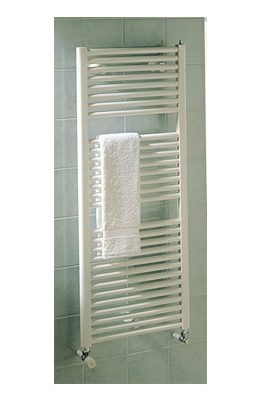
Towel warmers combine hydronic heat emission with towel warming and are most relevant to bathrooms and similar spaces. The models in this category are 24 inches wide and are available in approximately 26-inch and 44-inch heights.
The smaller model produces approximately 2,028 BTU per hour at higher water temperature and approximately 1,500 BTU per hour at lower temperature. The larger model produces approximately 2,932 BTU per hour at higher temperature and approximately 2,166 BTU per hour at lower temperature.
Choosing Between Towel Warmer Sizes
The larger towel warmer provides more heat, but the right size depends on the room load and intended purpose. If the unit is expected to contribute meaningful bathroom space heating, output needs to be compared with the calculated heat loss rather than selecting a model only from wall dimensions.
For a small, well-insulated bathroom, a towel warmer may provide a significant portion of the required heat. In a larger bathroom with exterior walls or extensive glazing, a separate radiator or other emitter may still be necessary.
Towel Warmer vs Wall Panel Radiator
Both products use hot water from a hydronic system, but their priorities differ. A wall panel radiator offers more flexibility for sizing primary room heat, while a towel warmer combines lower-output heating with a specific bathroom comfort function.
Wall Panel Radiators vs Hydronic Baseboards
Both systems heat rooms using boiler water, but they distribute emitter surface differently. Baseboard typically uses long runs near floor level, while wall radiators concentrate heating capacity into defined wall-mounted sections.
Wall panels can be useful where long uninterrupted baseboard runs are impractical or where furniture placement reduces usable perimeter space. The comparison should still be made from BTU output at the intended water temperature rather than linear dimensions alone.
Wall Panel Radiators vs Cast-Iron Radiators
Cast-iron radiators contain more mass and can continue releasing stored heat after water flow or burner operation changes. Aluminum wall radiators respond more quickly because they have less thermal mass.
Neither characteristic is automatically better for every home. Replacement decisions should consider room load, water temperature, control strategy, available wall space and whether the existing system's slower heating response is desirable.
Space Heating for Older Toronto Homes
Many older Toronto properties already use hydronic heating with radiators or baseboards. Wall panel radiators can provide another emitter option when renovating rooms, reclaiming wall space or replacing existing heating elements.
Existing piping should be assessed before assuming a direct replacement. Pipe arrangement, available flow, system pressure and water temperature determine whether a new emitter will provide its intended output.
Lower-Temperature Heating and Future System Changes
Emitter sizing can affect future heating-system flexibility. A room with generous radiator capacity can satisfy its heat loss at a lower water temperature than the same room with minimal emitter surface.
This can be valuable when optimizing a condensing boiler or evaluating lower-temperature hydronic equipment. An emitter selected only for high-temperature operation may become a limiting factor if the heat source changes later.
Space Heating Installation in Toronto and the GTA
Hydronic space heating installation should begin with room heat-loss calculations and an assessment of the existing boiler and distribution system. Radiator output, water temperature, flow, piping arrangement, valves, mounting position and available wall area all affect the final selection.
For replacement work, the installer should also determine why the existing room is being changed. Replacing an emitter because it leaks is different from replacing one because the room has always been cold, and the second situation requires a capacity and system-performance assessment before equipment is selected.
Radiator Placement and Room Performance
Emitter placement affects both installation practicality and how heat is distributed through a room. Exterior walls and areas near windows often experience greater heat loss, but modern layouts may limit available wall area in these locations.
A compact high-output radiator can help where space is constrained, but output should not be sacrificed simply to obtain the smallest possible footprint. The selected location must allow the emitter to release the heat required by the room.
Hydronic Piping and Radiator Valves
New radiators need compatible supply and return connections and sufficient water flow. Valve configuration also affects installation and room-level control.
When several emitters share a hydronic circuit, changing one radiator can influence system flow elsewhere. Replacement work should therefore consider balancing and circulation rather than treating each emitter as an isolated component.
Replacing Existing Radiators
Radiator replacement should compare the existing emitter's room-heating contribution with the proposed unit's output at the actual operating temperature. Matching height or width does not confirm equivalent performance.
This becomes especially important when an older boiler is being replaced at the same time. If the new heating strategy uses lower water temperatures, the replacement radiator may need more surface area than the original emitter to provide comparable room heat.
Replacing Baseboard With Wall Panel Radiators
Changing from hydronic baseboard to wall panel radiators can free perimeter wall space and change the appearance of a room, but the new radiator must replace the baseboard's heating output rather than simply its physical footprint.
The required panel size depends on room heat loss and design water temperature. Removing a long baseboard and installing an undersized panel can create a cold room even when the boiler and piping remain unchanged.
Lowering Boiler Temperature Without Resizing Emitters
A homeowner may reduce boiler water temperature to improve condensing operation but leave radiators sized for hotter water. Their heat output falls as water temperature drops, and the coldest rooms may no longer reach the thermostat setting during peak winter conditions.
Space Heating Installation Cost
Space heating cost depends on emitter type and size, number of radiators, piping modifications, valves, mounting requirements, system balancing and accessibility. Replacing an existing emitter with compatible connections can involve a different scope from adding hydronic heating to a new location.
Comparing radiator prices alone can therefore be misleading. A lower-priced emitter that requires extensive piping changes may result in a higher installed cost than a more suitable product that integrates cleanly with the existing system.
What to Check Before Selecting Hydronic Space Heating
The final choice should connect room-level heating demand with the temperatures and flow available from the hydronic system. These checks help prevent selecting an emitter that fits the wall but cannot provide the required winter output.
Space Heating Selection Checklist
- Calculate the design heat loss for each room being heated.
- Determine whether the emitter will provide primary or supplemental space heating.
- Confirm the boiler's intended supply and return water temperatures.
- Compare radiator BTU output at the actual design water temperature.
- Add sufficient emitter surface when designing for lower-temperature operation.
- Choose wall panel height and section count from required output and available wall space.
- Verify that a towel warmer provides enough output if it will serve as the bathroom's primary heat source.
- Check supply and return piping locations before selecting the radiator configuration.
- Confirm valve, vent and mounting requirements.
- Assess hydronic flow and system balancing when replacing existing emitters.
- Do not use a larger boiler to compensate for insufficient room emitter capacity.
- Recalculate emitter requirements if boiler operating temperatures will be reduced.
- Compare total installed cost, including piping and valves, rather than emitter price alone.
Choosing Space Heating for Toronto and the GTA
Space Heating products in this category provide two distinct hydronic options: modular wall panel radiators for room heating and towel warmers for targeted comfort applications. The correct product and size depend on room heat loss, available wall space, hydronic water temperature and the role the emitter needs to perform.
For Toronto and GTA installation or replacement, start with the required room BTU output and then select an emitter that can deliver that capacity at the system's actual design water temperature. This approach is particularly important when pairing new radiators with a condensing boiler or converting an older hydronic system to lower-temperature operation.
FREE In-Home Estimate