


Demand Duo® 2
Showing all 5 results
-
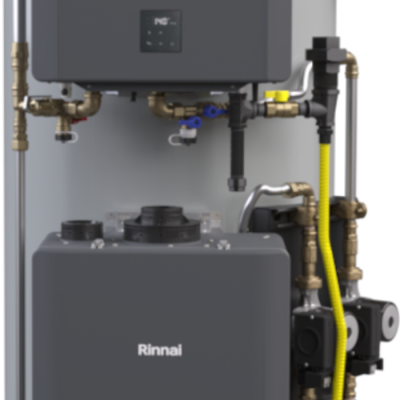
Rinnai Demand Duo 2 CHS320100HCXViN Tankless Water Heaters
-
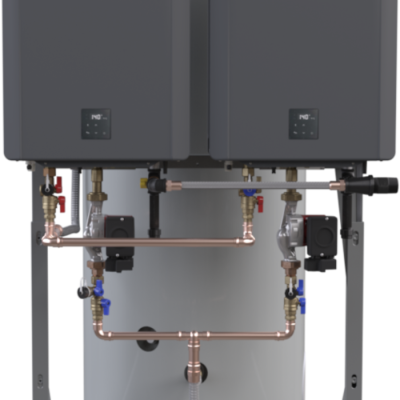
Rinnai Demand Duo 2 CHS398100HCXAiN Tankless Water Heaters
-
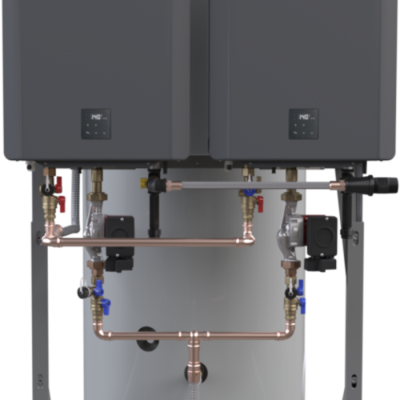
Rinnai Demand Duo 2 CHS398100HCXiN Tankless Water Heaters
-
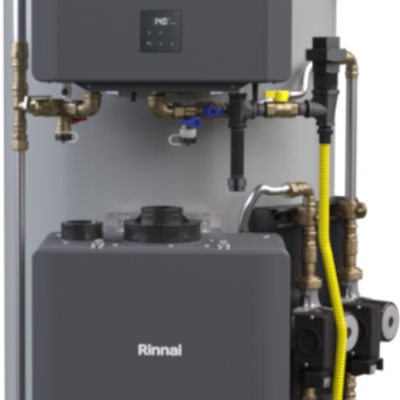
Rinnai Demand Duo 2 CHS398100HCXVAiN Tankless Water Heaters
-
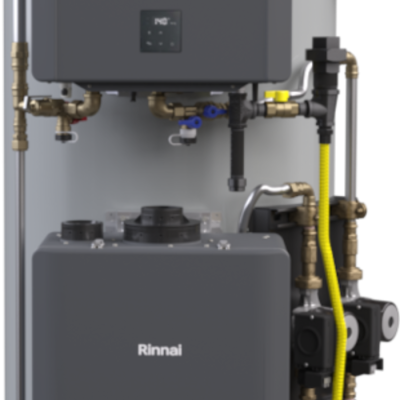
Rinnai Demand Duo 2 CHS398100HCXViN Tankless Water Heaters
Demand Duo 2 Commercial Hybrid Water Heating Systems
Demand Duo 2 systems are indoor condensing commercial hybrid water heaters that combine a large storage tank with two tankless heating engines. The dual-engine design provides high recovery, substantial first-hour hot-water delivery and built-in heating redundancy for commercial properties where losing hot water can interrupt operations.
For Toronto and GTA projects, selection should start with peak hot-water demand, recovery requirements and the operational value of redundancy. The current category includes configurations with different total heating inputs and equipment layouts, so maximum BTU capacity should not be the only selection factor.
Demand Duo 2 Capacity Options
The category includes 320,000 and 398,000 BTU/h configurations. Both use dual tankless heating engines and commercial storage, but the higher-input system provides greater recovery and first-hour delivery for more demanding applications.
Why Dual Tankless Engines Matter
The defining feature of Demand Duo 2 is the use of two tankless heating engines with commercial storage. Compared with a single-engine hybrid, the dual-engine arrangement increases available heating capacity and provides a second heating source if one engine is temporarily unavailable.
This distinction matters most in businesses where hot-water interruption has an operational consequence. A larger storage tank can provide a temporary reserve, but storage alone does not create heating redundancy once the stored hot water is depleted.
How to Select a Demand Duo 2 System
Commercial water-heater selection should reflect how much hot water the facility needs, how quickly that demand occurs and how quickly the system must recover. Redundancy should then be evaluated separately from capacity because the two requirements solve different operational problems.
Peak Hot-Water Demand
Measure the largest expected draw during the busiest operating period. Short demand spikes can require significant stored capacity even when average daily consumption is moderate.
Recovery Requirement
Closely spaced high-demand periods place greater value on recovery. The 398,000 BTU/h configuration provides more recovery than the 320,000 BTU/h option.
Redundancy
Two heating engines reduce dependence on one heat source. This can be more valuable than additional storage where loss of hot water would disrupt business operations.
Mechanical-Room Space
Equipment dimensions, installation path and service clearances need to be checked before selection. Configuration can affect footprint even when heating capacity is similar.
Gas Capacity
A system approaching 400,000 BTU/h creates a substantial gas load. Existing commercial gas piping should be verified before treating the project as a direct replacement.
Condensing Infrastructure
High-efficiency operation requires suitable venting and condensate management. These requirements can materially affect retrofit cost.
398,000 BTU/h Demand Duo 2
The higher-capacity configuration operates with up to 398,000 BTU/h of total input. Its recovery reaches approximately 459 gallons per hour at a 100°F temperature rise, with first-hour delivery reaching approximately 551 gallons under the same test condition.
This output is useful for demanding commercial applications, but selecting it simply because it is the largest option can oversize the heating capacity. Facilities whose calculated load fits the 320,000 BTU/h configuration should compare the practical benefit of the additional recovery before moving up.
320,000 BTU/h Demand Duo 2
The 320,000 BTU/h configuration retains the dual-engine architecture while reducing total maximum heating input. Recovery is approximately 376 gallons per hour at a 100°F temperature rise, with first-hour delivery of approximately 460 gallons.
This configuration can provide the redundancy benefits of two heating engines without requiring the full 398,000 BTU/h input. It is particularly relevant when continuity matters but the facility's calculated recovery load does not justify the larger system.
First-Hour Delivery vs Recovery Rate
First-hour delivery and recovery describe different parts of commercial water-heater performance. First-hour delivery combines available stored hot water with the system's ability to heat additional water, while recovery describes how quickly heating capacity can replenish the system.
A facility with a major short-duration peak may place more emphasis on first-hour delivery. A business with repeated or continuous demand should pay closer attention to recovery because stored capacity alone cannot support heavy consumption indefinitely.
Peak Demand vs Continuous Hot-Water Demand
Two commercial properties can consume the same number of gallons per day and still require different water-heating systems. A large volume used within one hour creates a different load from the same volume spread evenly across an entire operating day.
Demand Duo 2 selection should therefore use a time-based demand profile. Restaurants, hotels, fitness facilities and other commercial properties should identify their busiest operating intervals rather than sizing from daily consumption alone.
Storage and Recovery Work Together
The hybrid design uses stored hot water to absorb demand spikes while the tankless engines provide active recovery. This allows the system to address both short high-volume draws and continued hot-water demand.
Increasing storage and increasing heating input are not interchangeable. More stored water improves the initial reserve, while more burner capacity increases how quickly that reserve can be replenished.
Avoid Sizing Only From Daily Hot-Water Consumption
Daily consumption is useful for energy planning, but it does not show when the water is needed. Commercial system sizing should identify peak duration and recovery time as well as total volume.
Daily Usage Looks Adequate but the Morning Peak Overwhelms the System
A commercial water heater is selected from total daily consumption without examining the busiest hour. The building uses much of its hot water during one concentrated period, causing demand to exceed the system's first-hour capability even though total daily capacity appeared sufficient.
Demand Duo 2 vs Single-Engine Hybrid Water Heating
A single-engine hybrid combines storage with one tankless heating source, while Demand Duo 2 uses two heating engines. The dual-engine arrangement increases maximum heating capacity and provides heating redundancy.
Demand Duo 2 vs Two Conventional Commercial Tanks
Two conventional commercial tanks can provide storage, heating capacity and some system redundancy, but they also require the floor area and piping associated with two complete tank heaters. Demand Duo 2 combines dual heating engines with one packaged storage-based system.
The better configuration depends on available space, required recovery, service strategy and existing infrastructure. A dual-tank system can provide tank-level redundancy, while Demand Duo 2 provides heating-engine redundancy within a more integrated configuration.
Demand Duo 2 vs Commercial Tankless Rack
A commercial tankless rack uses multiple tankless units to provide modular heating capacity, typically with little or no integral storage. Demand Duo 2 combines two tankless engines with a substantial stored-water reserve.
The hybrid approach can be advantageous where short high-volume draws make storage useful. A larger rack system may be more appropriate when modular expansion, very high continuous flow or additional heating-unit redundancy is more important than integrated storage.
97% Thermal Efficiency
Demand Duo 2 uses condensing heating technology with approximately 97% thermal efficiency. For commercial properties with significant annual hot-water consumption, efficiency can materially influence long-term operating cost.
High efficiency does introduce installation requirements that differ from atmospheric commercial tanks. Venting and condensate drainage should be evaluated as part of the conversion rather than considering efficiency independently from installation scope.
Condensing vs Non-Condensing Commercial Hybrid Systems
A condensing hybrid extracts additional heat from combustion gases, improving thermal efficiency compared with non-condensing equipment. The trade-off is the need for compatible venting and condensate management.
A non-condensing replacement may align more closely with existing Category I vent infrastructure in some buildings. Demand Duo 2 becomes more attractive when the higher efficiency, recovery and dual-engine architecture justify the required infrastructure changes.
Demand Duo 2 Venting
The dual condensing engines require an approved venting arrangement for combustion exhaust and air supply. Existing atmospheric commercial water-heater venting should not be assumed compatible with the new system.
Vent routing can influence equipment placement and installation cost. In older Toronto commercial buildings, mechanical rooms may have limited access to suitable exterior termination points, making vent planning an important part of system selection.
Condensate Management
Condensing operation produces condensate that needs an appropriate drainage path. A mechanical room that previously contained non-condensing equipment may not already have the drainage arrangement required for the new system.
Confirming drainage before equipment selection helps prevent unexpected installation work. Where gravity drainage is impractical, the installation design may require another approved method of condensate removal.
Gas Supply for 320,000 and 398,000 BTU/h Systems
Dual-engine systems create a substantially larger gas load than many conventional single commercial water heaters. Gas piping needs to support the selected system together with boilers, kitchen equipment and other gas appliances connected to the building.
Pipe diameter by itself is not enough to establish capacity. Developed length, pressure, fittings and total connected load need to be considered before confirming that existing gas infrastructure can support the installation.
Indoor Installation and Mechanical-Room Planning
Demand Duo 2 is designed for indoor installation. Current configurations are approximately 33 inches wide, 79 inches high and 40 inches deep, with system weight around 530 pounds before considering operating water weight.
The equipment therefore needs to be evaluated against the complete access path as well as the final mechanical-room location. Doorways, stairs, elevators, floor loading and service clearance can rule out an installation even when the room itself appears large enough.
Vertical Configuration and Space Use
Some Demand Duo 2 configurations stack the two tankless heating engines vertically. This reduces the horizontal footprint compared with arrangements that place heating equipment side by side.
Vertical packaging is particularly useful in commercial mechanical rooms where floor area is limited, but ceiling height and service access must still be checked. A smaller footprint is only beneficial when technicians can safely reach the components that require maintenance.
Natural Gas and Propane Options
Demand Duo 2 configurations are available for natural gas and propane applications. Fuel selection should match the building's available supply and properly designed gas infrastructure.
Changing fuel does not remove the need for load calculations. The gas system must be capable of supplying the total input of both heating engines while maintaining required conditions for other connected appliances.
Replacing a Commercial Storage Water Heater
Demand Duo 2 can replace conventional commercial storage equipment where the building requires greater recovery, high efficiency or dual-engine redundancy. The hybrid architecture preserves stored hot water while changing how that storage is heated.
Replacement should not be approached as a gallon-for-gallon swap. The existing tank's storage, burner input, recovery and actual peak performance should be compared with the proposed hybrid system before the final configuration is selected.
Replacing Two Commercial Water Heaters
A dual-engine hybrid may be considered when an existing installation uses two conventional commercial tanks, particularly where mechanical-room space is constrained. The comparison should include total storage, recovery, redundancy and service strategy.
One hybrid system with two heating engines does not provide exactly the same redundancy as two completely independent tanks. If losing the storage vessel itself would stop operations, retaining multiple independent systems may still be appropriate.
Heating Redundancy vs Full System Redundancy
The two tankless engines provide heating redundancy, but they share other parts of the packaged system. This distinction matters for facilities where uninterrupted hot water is essential.
If the requirement is to maintain operation through any single equipment failure, system-level redundancy may require more than one complete water-heating system. Demand Duo 2 reduces dependence on one heating engine but should not be treated as identical to two fully independent systems.
Commercial Recirculation
Demand Duo 2 is recirculation capable, but building hot-water recirculation should be designed around the distribution system rather than confused with the internal recovery process. Large commercial buildings can have substantial piping distances between the mechanical room and fixtures.
An inadequately designed distribution loop can produce long waits or unnecessary heat loss even when the water heater itself has ample capacity. Water-heater sizing and building recirculation therefore need to be evaluated as separate but related design decisions.
Controls and Building Management Systems
Commercial properties may require centralized monitoring of water-heating equipment. Demand Duo configurations can support building-management integration and connected monitoring where those capabilities are part of the facility's control strategy.
The value depends on the application. For critical facilities, remote visibility and fault monitoring can improve response to equipment problems; for simpler installations, correct sizing and accessible service may provide greater practical value than advanced integration.
Water Quality and Maintenance
Dual tankless engines, pumps and commercial storage create multiple service points, so mechanical-room layout should allow technicians to access each component. Water quality can also influence scale accumulation and maintenance requirements in the heating circuits.
Restricting access to achieve the smallest possible installation footprint can increase future service difficulty. Installation planning should balance space savings with adequate access for inspection, flushing and component replacement.
Demand Duo 2 Installation Cost
Total installed cost depends on more than equipment capacity. Gas-line upgrades, venting, condensate drainage, electrical work, water piping, recirculation changes, equipment removal and physical access can all affect the project.
A planned replacement provides the opportunity to compare those infrastructure costs with future energy use and operational requirements. For an emergency replacement, installation compatibility and the ability to restore adequate hot water quickly may carry more weight.
When Demand Duo 2 Is a Good Fit
Demand Duo 2 is particularly relevant for commercial properties that need both stored hot water and high recovery, while also placing value on dual heating engines. It can suit applications with concentrated demand peaks, sustained usage or significant operational consequences when hot water is unavailable.
A single-engine hybrid may be sufficient for lower loads, while a larger multi-unit tankless system may be more appropriate for applications requiring greater modularity or continuous capacity. Multiple independent systems should also be considered when full equipment redundancy is a requirement.
Demand Duo 2 Selection Checklist
Before choosing a 320,000 or 398,000 BTU/h configuration, establish the facility's actual demand profile and decide how much redundancy the operation requires. Installation infrastructure should then be verified against the selected capacity.
Plan a Demand Duo 2 Commercial Installation
- Calculate the facility's busiest-hour hot-water demand.
- Identify short high-volume peaks separately from continuous demand.
- Determine the recovery required between consecutive high-use periods.
- Compare 320,000 and 398,000 BTU/h configurations using actual recovery requirements.
- Evaluate first-hour delivery rather than storage capacity alone.
- Determine whether dual heating-engine redundancy has operational value for the business.
- Decide whether heating redundancy is sufficient or full system redundancy is required.
- Select the appropriate natural gas or propane configuration.
- Verify gas capacity for both heating engines and all other connected appliances.
- Plan an approved condensing vent arrangement.
- Confirm a practical condensate drainage route.
- Review building recirculation requirements separately from water-heater recovery.
- Confirm electrical, control and monitoring requirements.
- Measure the mechanical room and the complete equipment access route.
- Provide sufficient clearance for both tankless engines, pumps and controls.
- Compare total installed cost, operating efficiency and service requirements before final selection.
Choosing Demand Duo 2 in Toronto and the GTA
Demand Duo 2 provides a commercial hybrid approach for properties that need substantial storage-supported delivery, up to 398,000 BTU/h of heating input and dual-engine redundancy. The 320,000 BTU/h configuration offers the same general dual-engine strategy at a lower maximum input for facilities whose calculated recovery requirement is lower.
For Toronto and GTA commercial installations, the final choice should account for peak and first-hour demand, recovery, gas capacity, condensing venting, condensate drainage, mechanical-room access and the business impact of hot-water interruption. These factors determine whether the dual-engine hybrid design provides a meaningful advantage over a single-engine hybrid, conventional commercial tank or multi-unit tankless system.
FREE In-Home Estimate