


Demand Duo H-Series
Showing all 4 results
-
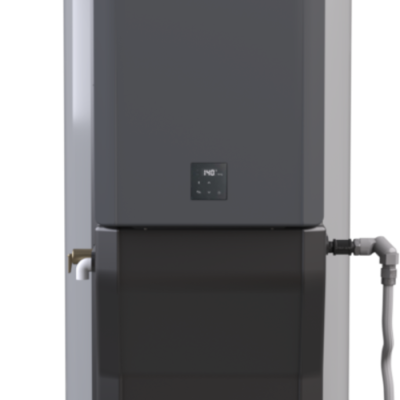
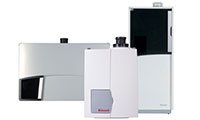
Rinnai Demand Duo H-Series CHS160100HCXiN Tankless Water Heaters
-
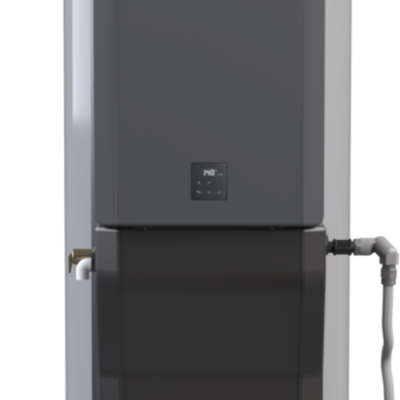
Rinnai Demand Duo H-Series CHS16080HCXiN Tankless Water Heaters
-
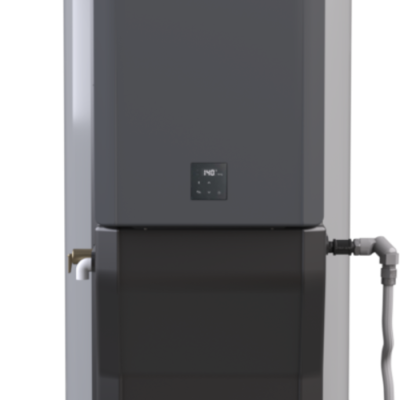
Rinnai Demand Duo H-Series CHS199100HCXiN Tankless Water Heaters
-
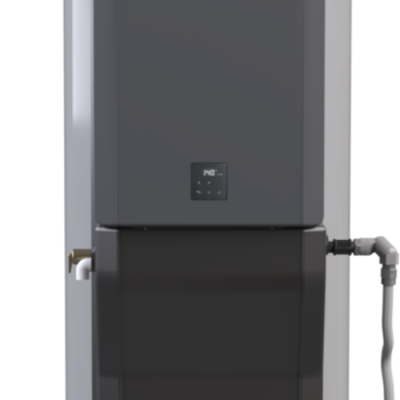
Rinnai Demand Duo H-Series CHS19980HCXiN Tankless Water Heaters
Demand Duo H-Series Condensing Commercial Water Heaters
Demand Duo H-Series systems are indoor condensing commercial hybrid water heaters that combine a storage tank with a tankless heating engine and recovery pump. They are designed for commercial applications that need stored hot water for short demand spikes, strong recovery for sustained use and higher thermal efficiency than non-condensing hybrid systems.
The category includes 80-gallon and 100-gallon configurations with different heating capacities. Selecting the right system requires matching tank volume and burner output to the building's peak demand, recovery requirement, mechanical-room conditions and existing gas and venting infrastructure.
Demand Duo H-Series Models and Capacities
The H-Series provides more than one way to increase hot-water performance. Within the single-engine configurations, buyers can change heating input, storage volume or both, so the correct model should reflect how the building actually consumes hot water.
Choose Storage Capacity and Recovery Separately
Tank size and burner input solve different hot-water problems. An 80-gallon and 100-gallon system can share the same maximum heating input while behaving differently during a short, high-volume draw because the larger tank starts with more stored hot water.
Increasing burner input without increasing tank size addresses recovery instead. A facility with repeated demand periods may benefit more from faster recovery than from carrying an additional 20 gallons of storage throughout the day.
How to Select an H-Series Configuration
Commercial water-heater sizing should start with the facility's peak demand profile rather than its floor area or existing tank size. The duration and frequency of high-use periods determine whether additional storage, additional recovery or both provide meaningful value.
Peak Demand
Identify the largest expected hot-water draw over a defined period. Short high-volume events place different demands on the system than steady continuous use.
Tank Volume
Choose between 80 and 100 gallons from the amount of stored water needed to buffer peak demand, not simply from the size of the existing tank.
Recovery Rate
Higher burner input becomes valuable when the tank must recover quickly before another demand period begins.
Thermal Efficiency
The condensing platform reaches approximately 97% thermal efficiency, making it particularly relevant when energy performance is a priority in a high-use application.
Venting
Condensing equipment has different venting requirements from atmospheric commercial tanks, so an existing B-Vent system should not be assumed reusable.
Mechanical Room
Tank dimensions, service clearance, equipment access, gas piping and condensate drainage can determine which configuration is practical to install.
80-Gallon Demand Duo H-Series
The 80-gallon configuration is available with multiple heating inputs, allowing recovery capacity to increase without increasing storage volume. This is useful when the facility has enough stored capacity for its peak draw but needs the tank to recover faster between demand periods.
The distinction between the 130,000, 160,000 and 199,000 BTU/h configurations is therefore important. Selecting the highest input automatically can add capacity that the building does not need, while selecting too little recovery can leave the system behind during repeated high-use periods.
100-Gallon Demand Duo H-Series
The 100-gallon configurations provide a larger stored reserve for applications with heavier short-duration draws. Available 160,000 and 199,000 BTU/h configurations allow the larger tank to be paired with different recovery requirements.
The additional storage is most valuable when the demand profile requires it. If an 80-gallon system already covers the peak draw and recovers before the next event, moving to 100 gallons may consume additional mechanical-room space without producing a meaningful operational advantage.
130,000 vs 160,000 vs 199,000 BTU/h
Higher maximum input increases the rate at which the tankless engine can add heat to the system. That can shorten recovery time and support heavier sustained demand, but maximum input should be matched to the actual commercial load.
For facilities with long periods between peak draws, storage may have ample time to recover even with lower input. Operations with closely spaced demand peaks place greater value on faster recovery and may justify a higher-input configuration.
Peak Demand vs Continuous Heavy Use
A restaurant with concentrated wash periods, a hotel with morning shower demand and a facility with continuous process hot water can require very different system behaviour even when their total daily consumption is similar.
Storage helps absorb short spikes, while recovery capacity becomes increasingly important as high demand continues. The H-Series should therefore be selected from the shape of the load rather than daily gallons alone.
Avoid Matching the Existing Tank by Gallons Alone
A hybrid system produces and stores hot water differently from a conventional commercial tank. Matching the old tank's gallon rating without evaluating recovery can either oversize the replacement or leave it unable to recover between peak periods.
A 100-Gallon Tank Does Not Automatically Require a 100-Gallon Replacement
An existing commercial tank is replaced solely by matching its storage volume. The actual load could have been served by an 80-gallon hybrid with stronger recovery, or it may require both larger storage and higher recovery. Without a demand calculation, tank volume alone cannot distinguish between these outcomes.
How the Hybrid Heating System Works
The H-Series heats water through a tankless engine and circulates that heated water through the storage tank. The tank therefore provides stored capacity while the separate heating engine provides recovery.
This arrangement differs from a conventional commercial tank where burner heat is applied directly to the storage vessel. The separation between heat generation and storage is an important consideration when comparing serviceability, tank life and replacement strategy.
97% Thermal Efficiency
The H-Series reaches approximately 97% thermal efficiency through condensing operation. In commercial applications with substantial hot-water consumption, the efficiency difference between condensing and non-condensing equipment can become more significant than it would be in a low-use installation.
Efficiency should still be considered together with project scope. Replacing an atmospheric tank with condensing equipment can require new venting and condensate drainage, so operating efficiency and installation requirements need to be evaluated together.
Demand Duo H-Series vs R-Series
Both categories combine tank storage with tankless-driven recovery, but the H-Series uses condensing technology while the R-Series is a non-condensing hybrid. That difference affects efficiency, venting and replacement strategy.
H-Series vs Conventional High-Efficiency Commercial Tank
A conventional high-efficiency commercial tank integrates the heating process into the storage appliance. The H-Series separates heat generation through the tankless engine from the storage function of the tank.
This can make component replacement and maintenance different from replacing an entire integrated tank heater. The trade-off is that the hybrid system has its own pump, controls and tankless components that must remain accessible for service.
H-Series vs Commercial Tankless Rack
A commercial tankless rack relies primarily on multiple tankless units to satisfy hot-water demand without the same large integrated storage volume. The H-Series retains stored water, which helps buffer short, intense demand spikes.
A rack can offer greater modular capacity and redundancy when multiple heating units are used, while a single-engine H-Series provides a more tank-like replacement format. Facilities with very high continuous demand or strict redundancy requirements should compare the system architectures rather than only total BTU input.
Demand Duo 2V for Higher Capacity and Redundancy
Higher-demand H-Series configurations are available with two vertically stacked tankless engines and two pumps. These systems increase heating capacity while introducing heating redundancy that a single-engine configuration cannot provide.
Dual-engine models can reach substantially higher total input, but the additional capacity should solve a defined load or redundancy requirement. A facility that fits comfortably within a single-engine configuration does not automatically benefit from moving to the larger platform.
Single Engine vs Dual Engine
A single-engine H-Series system is simpler when one tankless heating source provides enough recovery. Dual-engine configurations become more relevant when higher first-hour delivery, continuous demand or continued operation after one heating component is unavailable is important.
Redundancy should be evaluated separately from storage volume. A larger tank provides more stored water, but it does not create a second heating source if the primary engine is unavailable.
Commercial Redundancy Requirements
Loss of hot water can have very different consequences across commercial applications. Some properties can tolerate scheduled service, while restaurants, hotels, healthcare-related facilities and process applications may face operational disruption.
Where hot-water continuity is critical, the design should consider multiple heating sources rather than simply increasing the size of one appliance. Capacity and redundancy solve different problems.
Condensing Venting Requirements
The H-Series requires an approved condensing vent arrangement rather than the Category I B-Vent used by many atmospheric commercial water heaters. This is one of the most important installation differences when planning a retrofit.
A building with existing B-Vent should not assume that vent can be retained for the new condensing system. Vent route, termination, material and combustion-air configuration should be evaluated before equipment selection is finalized.
Condensate Drainage
Condensing operation creates water that must be drained appropriately. The mechanical room therefore needs a practical condensate route as part of the H-Series installation plan.
This can become a significant retrofit consideration in older Toronto and GTA buildings where the existing commercial tank did not require condensate disposal. Choosing equipment before confirming drainage can add unexpected installation work.
Gas Supply and Burner Capacity
Single-engine H-Series configurations can require up to 199,000 BTU/h, while larger dual-engine configurations can require substantially more gas input. Existing piping must be evaluated against the selected equipment and all other connected gas appliances.
Replacing a tank with a similar physical footprint does not guarantee that the existing gas system has sufficient capacity. Pipe length, pressure, fittings and total connected load all affect gas-system requirements.
Natural Gas and Propane Configurations
H-Series configurations are available for natural gas and propane applications. Fuel selection should match the building's existing supply and properly designed gas system rather than being used as a way to change hot-water capacity.
Confirming fuel type early is especially important for commercial replacement projects because equipment configuration and gas-system requirements need to be coordinated before installation.
Commercial Recirculation and Tank Recovery
The H-Series uses a recovery pump as part of the process of moving water between the tank and heating engine. This internal recovery function should not be confused with a building's domestic hot-water recirculation loop.
A large property may still require distribution recirculation to maintain acceptable hot-water delivery times at distant fixtures. Tank recovery and building recirculation solve different problems and should be designed separately.
Replacing a High-Efficiency Commercial Tank
The H-Series is designed as a practical alternative to high-efficiency commercial storage water heaters where hybrid storage and tankless recovery fit the building's demand. It can preserve the familiar concept of stored hot water while changing how that water is heated and recovered.
The replacement should still be treated as a system project. Venting, condensate, gas supply, water connections, electrical requirements and physical access can differ from the existing tank even when storage capacity is similar.
Emergency Commercial Water Heater Replacement
During an emergency replacement, restoring adequate hot water quickly becomes the priority. A hybrid configuration can be useful where commercial storage remains desirable, but the replacement still needs to satisfy peak demand and installation requirements.
Choosing capacity solely from the failed tank's nameplate can repeat previous oversizing or undersizing. Even under time pressure, existing tank size, burner input and actual operating demand should be reviewed together.
Planned Replacement and New Construction
A planned project provides more opportunity to compare storage, recovery, efficiency, redundancy and mechanical-room layout. This can reveal whether a single H-Series unit, dual-engine configuration or another commercial water-heating architecture better matches the building.
New construction also allows venting, condensate and gas infrastructure to be designed around the selected system instead of adapting equipment to existing conditions. That flexibility can materially affect the most practical configuration.
Mechanical-Room Space and Installation Access
The H-Series combines a commercial storage tank with tankless heating components in a compact packaged arrangement. Physical dimensions still matter because tank capacity and configuration affect equipment size and weight.
Door widths, stairs, elevators, mechanical-room clearance and service space should be measured before ordering equipment. A unit that fits the final location may still be impossible to move through the building without additional work.
Controls and Building Management Integration
Commercial applications may need monitoring or integration with a building management system. H-Series configurations support control and connectivity options that can be relevant where facility staff need centralized system visibility.
This capability matters most when the building already uses centralized controls or when hot-water operation is critical. For a smaller standalone application, complex integration may provide less value than correct sizing and straightforward service access.
Water Quality and Commercial Maintenance
The tankless heating engine and recovery system require maintenance planning appropriate to a high-use commercial appliance. Mineral accumulation and water conditions can affect heat transfer and long-term operation.
Service access should therefore be considered during equipment placement. A compact installation that prevents technicians from reaching the tankless engine, pump or controls can increase future maintenance difficulty even if it saves a small amount of mechanical-room space.
Demand Duo H-Series Installation Cost
Total installed cost varies with tank size, heating capacity and the building modifications required. Vent conversion, condensate drainage, gas-line changes, water piping, electrical work, equipment removal and access constraints can all affect the project.
The lowest equipment price is therefore not necessarily the lowest installed or operating-cost option. A commercial comparison should consider installation scope, expected hot-water demand, efficiency and future service requirements together.
When the Demand Duo H-Series Is a Good Fit
The H-Series is particularly relevant when a commercial property needs stored hot-water capacity, strong recovery and condensing efficiency in one packaged system. Its range of storage and heating capacities allows the system to be selected around different combinations of peak demand and recovery.
A non-condensing hybrid may be more practical where retaining compatible B-Vent infrastructure is a priority, while a multi-unit tankless system may be preferable when modular capacity or greater system-level redundancy is required. The choice should follow the facility's demand profile and installation conditions.
Demand Duo H-Series Selection Checklist
Before choosing a model, establish the commercial hot-water load and determine whether the project needs additional storage, additional recovery or both. Installation infrastructure should then be verified against the selected configuration.
Select the Right H-Series Configuration
- Calculate peak hot-water demand during the facility's busiest operating period.
- Identify how long peak demand lasts rather than relying only on daily consumption.
- Determine how quickly stored hot water must recover before the next demand period.
- Compare 80-gallon and 100-gallon storage requirements separately from burner input.
- Choose between 130,000, 160,000 and 199,000 BTU/h single-engine capacity where applicable.
- Evaluate a dual-engine configuration when higher output or heating redundancy is required.
- Confirm the correct natural gas or propane configuration.
- Verify gas-piping capacity for the selected system and other connected equipment.
- Plan an approved condensing vent route rather than assuming existing B-Vent can be reused.
- Confirm a practical condensate drainage route.
- Verify water piping and building recirculation requirements.
- Confirm electrical and control requirements.
- Measure equipment access routes as well as the final mechanical-room location.
- Allow sufficient service clearance around the tankless engine, pump and controls.
- Consider building management integration where centralized monitoring is required.
- Compare total installation scope and operating requirements rather than equipment price alone.
Choosing Demand Duo H-Series in Toronto and the GTA
Demand Duo H-Series selection should begin with the building's peak hot-water demand and required recovery time. The available combinations of 80-gallon and 100-gallon storage with different heating inputs allow storage and recovery to be matched more closely than selecting a commercial water heater from tank volume alone.
For Toronto and GTA commercial projects, condensing venting, condensate drainage, gas capacity, mechanical-room access, recirculation and service requirements should be evaluated before the final configuration is selected. Facilities where hot-water interruption has a significant operational impact should also evaluate whether a single-engine system provides enough redundancy.
FREE In-Home Estimate