


Indoor Air Quality
Showing 1–9 of 45 results
-
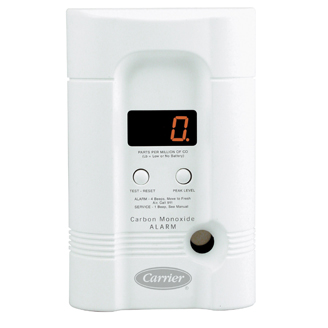
Carrier Carbon Monoxide (CO) Alarm – COALM Indoor Air Quality
-
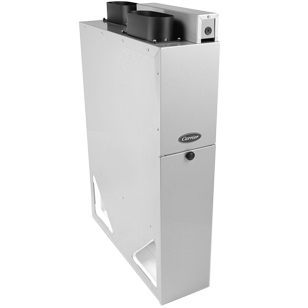
Carrier Comfort Energy Recovery Ventilator – ERVXXNVA1090 Indoor Air Quality
-
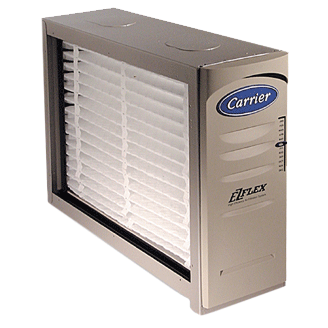
Carrier Comfort EZ Flex Cabinet Air Filter – EZXCAB Indoor Air Quality
-

Carrier Infinity Air Purifier – GAPAA Indoor Air Quality
-
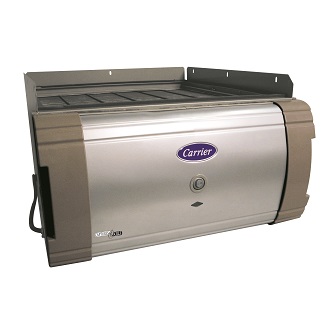
Carrier Infinity Air Purifier – GAPAB Indoor Air Quality
-
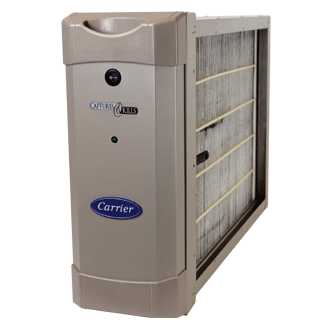
Carrier Performance Air Purifier – PGAP Indoor Air Quality Indoor Air Quality
-
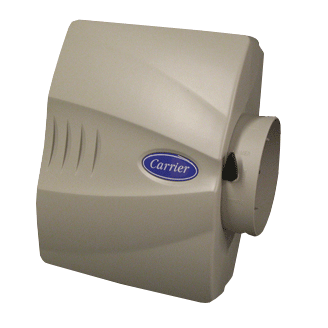
Carrier Performance Bypass Humidifier – HUMCCLBP Indoor Air Quality
-
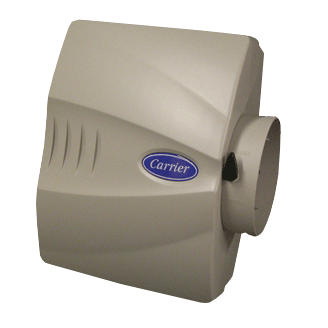
Carrier Performance Bypass Humidifier – HUMCCSBP Indoor Air Quality
-
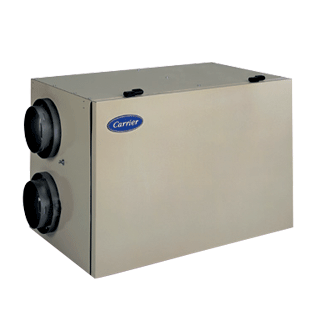
Carrier Performance Energy Recovery Ventilator – ERVXXLHB1200 Indoor Air Quality
Indoor Air Quality Systems for Healthier Home Air
Indoor air quality describes the condition of the air inside a home and the pollutants, moisture levels and ventilation conditions that affect it. HVAC-based indoor air quality systems can help manage airborne particles, fresh-air exchange and humidity, but the right solution depends on the specific problem rather than adding one device and expecting it to address every concern.
For Toronto and GTA homes, system selection should account for seasonal heating and cooling, winter dryness, summer humidity, outdoor fine particles and the home's ventilation and ductwork. The practical approach is to identify the problem first, then choose filtration, air purification, ventilation or humidity control for that specific need.
Choosing the Right Indoor Air Quality Solution
Different indoor air quality systems perform different jobs. Matching the equipment to the contaminant or comfort problem prevents unnecessary upgrades and makes it easier to compare installation requirements and long-term performance.
Airborne Particles
Higher-efficiency filtration and air purification can reduce particles that pass through the system. Filter efficiency must still be compatible with HVAC airflow.
Stale Indoor Air
Mechanical ventilation exchanges indoor and outdoor air. Increasing filtration alone cannot provide the fresh-air exchange that an airtight home may require.
Dry Winter Air
A whole-home humidifier can add moisture during Toronto's heating season. Air purification does not correct low indoor humidity.
Excess Humidity
Dehumidification can remove excess moisture when cooling or ventilation alone does not maintain suitable humidity. Persistent moisture sources should also be corrected.
Odours and Gases
Ordinary particle filters have limited ability to address gases and odours. Source control, ventilation or suitable carbon filtration may be more relevant.
Biological Treatment
UV equipment can supplement other air quality measures for specific biological treatment objectives, but it does not replace particle filtration or moisture control.
Filtration, Ventilation or Humidity Control?
These systems are frequently grouped under indoor air quality, but they are not interchangeable. Compare the problem each one addresses before deciding which equipment belongs in the HVAC system.
Air Filtration for Dust, Pollen and Fine Particles
Filtration is one of the most direct HVAC solutions when airborne particles are the primary concern. Higher-efficiency media can capture smaller particles than basic equipment-protection filters, but filtration only works on air that actually passes through the media.
Choosing the highest available filtration rating without checking the HVAC system can create unnecessary airflow resistance. Filter efficiency, cabinet dimensions, blower performance and duct design should therefore be evaluated together.
Whole-Home Air Purification vs Standard HVAC Filtration
A standard HVAC filter may primarily protect heating and cooling equipment from debris, while whole-home purification can place greater emphasis on reducing smaller airborne particles or adding another treatment technology. The difference matters when indoor air quality rather than equipment protection is the main objective.
More treatment stages do not automatically mean better performance for every home. A simpler filtration upgrade may be sufficient for particle concerns, while carbon or UV treatment should be considered only when those technologies address an identified need.
Ventilation for Fresh-Air Exchange
Mechanical ventilation addresses a different problem from filtration by replacing stale indoor air with outdoor air in a controlled way. This can be particularly important in tighter homes where natural leakage does not provide dependable air exchange.
Heat recovery and energy recovery ventilation can reduce the energy penalty associated with bringing outdoor air into a conditioned home. Choosing between ventilation strategies should account for winter humidity, summer moisture, airflow requirements and how the system will integrate with existing ductwork.
HRV vs ERV for Toronto and GTA Homes
Heat recovery ventilators transfer heat between outgoing and incoming airstreams, while energy recovery ventilators can transfer both heat and some moisture. The choice therefore involves more than simply selecting a fresh-air system.
Homes that struggle with excess winter humidity may have different ventilation needs from homes that become very dry. Airtightness, occupancy, existing humidity levels and HVAC configuration should be considered before choosing between HRV and ERV equipment.
Whole-Home Humidification for Toronto Winters
Indoor air can become dry during the heating season as cold outdoor air enters the home and is warmed. Whole-home humidifiers add moisture through the central HVAC system, providing a different solution from portable room humidifiers.
More humidity is not always better. Excess winter moisture can contribute to condensation on cold windows and building surfaces, so humidification should respond to actual indoor conditions rather than maintaining an aggressive fixed setting throughout the winter.
Dehumidification for Excess Indoor Moisture
Air conditioning removes some moisture while cooling, but it may not always provide enough dehumidification during humid weather or low cooling-load conditions. A whole-home dehumidifier can provide dedicated moisture removal when humidity remains elevated.
Dehumidification should not be used to hide an active water problem. Plumbing leaks, foundation moisture, drainage issues and other sources should be corrected rather than relying on HVAC equipment to continuously manage the resulting moisture.
Indoor Humidity and System Selection
For many homes, an indoor relative humidity range around 30% to 50% can provide a useful operating target, but the appropriate level changes with season and building conditions. During very cold Toronto weather, a lower indoor humidity setting may be necessary to limit window and surface condensation.
Humidity should therefore be treated as a measured condition rather than a reason to install both humidification and dehumidification automatically. Some homes need one, some need the other seasonally, and others may already maintain acceptable levels without dedicated equipment.
Indoor Air Quality During Wildfire Smoke and Poor Outdoor Air
Fine particulate matter from wildfire smoke and other outdoor pollution can enter homes through ventilation, doors, windows and normal building leakage. During poor outdoor air conditions, effective particle filtration and appropriate HVAC recirculation can help reduce indoor particle concentrations.
Ventilation strategy may need to change temporarily when outdoor air quality is poor. Bringing in more outdoor air is not always the correct response, which is why ventilation and filtration need to be considered together rather than treating maximum fresh-air intake as universally beneficial.
Source Control Comes Before Adding Equipment
HVAC equipment can reduce certain airborne contaminants, but removing or reducing the pollution source is often the first step. Smoke, excessive moisture, strong chemical emissions, combustion problems and improperly exhausted cooking pollutants should not be managed solely by installing more air-cleaning equipment.
Air Cleaning Is Used to Mask an Ongoing Source
A home has persistent moisture and mould growth, so stronger air purification is installed without correcting the water source. The system may capture some airborne particles, but the moisture problem continues and biological growth can return.
Airflow Can Limit Indoor Air Quality Performance
Whole-home filters and air purifiers depend on the HVAC system to move air through the treatment equipment. Weak return-air pathways, restrictive filters or poorly balanced ductwork can limit how effectively air from different rooms reaches the system.
This creates an important trade-off when upgrading filtration. Higher particle-capture efficiency is useful only when the HVAC system can maintain the airflow required for heating and cooling operation.
Indoor Air Quality Systems for Older Toronto Homes
Older Toronto and GTA homes can present installation constraints such as limited mechanical-room space, older duct layouts and uneven return-air distribution. These conditions can influence whether a larger media cabinet, whole-home purifier, ventilator or humidity-control system can be integrated without substantial modification.
Older homes should not automatically be considered well ventilated simply because they are less airtight. Natural air leakage is uncontrolled and changes with weather, so persistent air quality or moisture concerns should be evaluated rather than relying on drafts as a ventilation strategy.
Indoor Air Quality Systems for Newer and Tighter Homes
Newer construction can reduce uncontrolled air leakage, which improves energy performance but increases the importance of planned ventilation. Filtration alone cannot replace the fresh-air exchange required when stale air and internally generated pollutants accumulate.
A tighter home may therefore benefit more from coordinated ventilation and filtration than from simply installing the strongest air purifier available. Humidity should also be considered because occupancy and everyday activities can add significant indoor moisture.
Indoor Air Quality Installation With a Furnace or Heat Pump
Furnace, air-handler or ducted heat-pump replacement can be a practical time to evaluate indoor air quality upgrades. Return-air transitions, electrical connections and ductwork may already be changing, making it easier to plan filtration, purification or ventilation equipment as part of the complete system.
The heating and cooling replacement should not dictate which air quality accessories are installed. Each component should still solve a defined problem and be sized or configured for the home's airflow and indoor conditions.
Replacing Existing Indoor Air Quality Equipment
Replacing an older filter cabinet, purifier, ventilator, humidifier or dehumidifier is an opportunity to reassess the original problem rather than automatically installing the same type of equipment. Building upgrades, new HVAC equipment and changes in occupancy can alter what the home needs.
Existing duct connections may simplify replacement, but they should not force a poor equipment choice. Airflow, capacity, controls, drainage, electrical requirements and service access should be reviewed before selecting the replacement.
Indoor Air Quality System Cost
Indoor air quality costs vary widely because filtration, ventilation, purification and humidity control require different equipment and installation work. A filter upgrade may involve a media cabinet, while a ventilator can require outdoor penetrations and ductwork, and a dehumidifier can require drainage and additional air-distribution planning.
Comparing equipment prices alone can therefore be misleading. Installation modifications, replacement filters, maintenance, electrical requirements and consumable components should be included when comparing long-term cost.
Avoid Solving the Wrong Indoor Air Quality Problem
Symptoms such as stale air, visible condensation, dust accumulation or persistent odours can have different causes. Installing equipment before identifying the underlying issue can result in a system that operates correctly but does little to solve the actual problem.
An Air Purifier Is Installed for a Ventilation Problem
A tightly constructed home feels stale, so stronger filtration is added. Particle capture may improve, but the purifier does not introduce outdoor air or exhaust accumulated indoor pollutants, leaving the original ventilation issue unresolved.
Indoor Air Quality Selection Checklist
Start by identifying the specific pollutant, moisture condition or ventilation problem before selecting equipment. Then evaluate how the proposed solution will interact with the home's existing HVAC system and seasonal conditions.
Plan the Right Indoor Air Quality System
- Identify whether the main concern is particles, stale air, odours, low humidity, excess humidity or a combination of conditions.
- Reduce or remove controllable pollutant sources before relying on HVAC equipment.
- Use filtration or air purification when airborne particle reduction is the primary objective.
- Check HVAC airflow before increasing filter efficiency.
- Consider mechanical ventilation when the home needs controlled fresh-air exchange.
- Compare HRV and ERV operation using the home's actual winter and summer humidity conditions.
- Add humidification only when indoor air becomes too dry during the heating season.
- Use dehumidification when excess moisture persists after active moisture sources have been addressed.
- Consider carbon treatment separately when gases or odours are part of the concern.
- Use UV treatment only when it serves a defined biological treatment objective.
- Account for outdoor air quality when planning ventilation and filtration during smoke events.
- Confirm available duct space, electrical requirements, drainage and service clearance before installation.
- Reassess air quality needs when replacing a furnace, air handler or heat pump.
- Include filters, replacement components and maintenance when comparing long-term ownership costs.
Choosing Indoor Air Quality Systems in Toronto and the GTA
The right indoor air quality solution depends on what needs to change inside the home. Filtration targets airborne particles, ventilation manages air exchange, humidifiers address dry conditions, dehumidifiers remove excess moisture and supplemental purification technologies serve more specific treatment objectives.
For Toronto and GTA homes, seasonal humidity, outdoor air conditions, building airtightness and HVAC configuration should be considered together. A targeted system selected for the actual problem is more useful than adding multiple indoor air quality products without a clear purpose.
FREE In-Home Estimate