


Dehumidifiers
Showing the single result
Whole-Home Dehumidifiers for Humidity Control
Dehumidifiers remove excess moisture from indoor air to help maintain a more comfortable humidity level. Whole-home models can be integrated with ducted HVAC systems to control moisture across multiple rooms, while also offering a higher-capacity alternative to portable units for humid basements and larger areas.
For Toronto and GTA homes, the right system depends on moisture-removal capacity, the size and condition of the space, drainage, duct configuration and how independently the dehumidifier needs to operate from the air conditioner. Choosing by floor area alone can lead to poor humidity control when moisture loads are unusually high.
How to Choose a Whole-Home Dehumidifier
Capacity is important, but it is only one part of system selection. The source and severity of the humidity, installation configuration and drainage requirements determine whether the equipment will provide practical long-term control.
Moisture-Removal Capacity
Compare how many pints of water the system can remove per day. Higher moisture loads require greater capacity, but unnecessary oversizing can add cost without solving the underlying moisture source.
Whole-Home vs Targeted Control
A ducted installation can manage humidity across multiple areas, while an independent configuration can target a persistently damp basement or another specific space.
Drainage
Whole-home systems remove substantial amounts of water and need reliable continuous drainage. Drain location can influence equipment placement and installation complexity.
HVAC Integration
Integrated installation can use existing ductwork for air distribution, but available space, return-air design and system airflow need to support the selected configuration.
Independent Operation
A self-contained dehumidifier can remove moisture when the air conditioner does not need to run, which is valuable during humid but mild weather.
Energy Efficiency
Dehumidification can require substantial runtime during humid periods. Efficiency becomes increasingly important as moisture load and operating hours increase.
Whole-Home vs Portable Dehumidifiers
Portable and whole-home dehumidifiers use similar refrigeration principles, but their capacity, drainage and air-distribution strategies are different. The better choice depends on whether excess humidity is confined to one area or affects a larger portion of the home.
Performance Whole-Home Dehumidifier
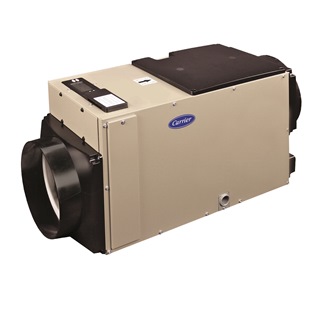
The Performance whole-home category uses self-contained refrigeration equipment with its own blower, coil and compressor, allowing the system to remove moisture independently of the home's cooling equipment. Current configurations can remove up to approximately 100 pints of moisture per day, with different capacities available for different moisture loads.
This independent operation is an important distinction from relying solely on air conditioning for humidity control. The dehumidifier can respond to humidity even when the indoor temperature does not require active cooling.
Choosing Between Dehumidifier Capacities
Whole-home dehumidifiers are available in different moisture-removal capacities so equipment can be matched more closely to the application. Capacity should reflect the actual moisture load rather than simply selecting the largest model available.
A lower-capacity configuration may be sufficient for moderate whole-home humidity or a targeted basement application. Higher-capacity equipment becomes more relevant for larger spaces or more persistent moisture loads, provided the source of the moisture has also been evaluated.
What Pints per Day Really Means
Dehumidifier capacity is expressed as the amount of water the equipment can remove from the air over a defined period under specified test conditions. A higher pint-per-day rating means greater moisture-removal potential, not necessarily better performance for every home.
Actual water removal changes with indoor temperature and relative humidity. A unit will not necessarily remove its maximum rated amount every day because real Toronto home conditions differ from standardized capacity-testing conditions.
Do Not Size a Dehumidifier by Square Footage Alone
Floor area provides a useful starting point, but moisture load can differ dramatically between two homes of identical size. Basement conditions, air leakage, occupancy, ventilation, water intrusion and outdoor humidity can all change how much moisture must be removed.
The Dehumidifier Is Sized Only From Floor Area
A system is selected from square footage without investigating why the basement remains damp. If moisture is continually entering through water intrusion or another building problem, the dehumidifier may run for long periods without correcting the underlying cause.
Whole-Home Dehumidifier vs Air Conditioner
Air conditioners remove some moisture while cooling, but their primary control target is temperature. A dedicated dehumidifier responds directly to humidity and can operate even when the home does not need additional cooling.
This difference becomes important during mild but humid weather. If indoor temperature reaches the thermostat setting before enough moisture has been removed, the air conditioner can stop while relative humidity remains higher than desired.
Why Air Conditioning May Not Control Humidity Enough
Air conditioners remove moisture when their indoor coil is cold and the system is running. Short cooling cycles or periods of mild weather can reduce the amount of time available for dehumidification.
Increasing cooling simply to reduce humidity can make the home colder than necessary and consume additional energy. A dedicated dehumidifier separates moisture control from temperature control when humidity remains a recurring problem.
Whole-Home Dehumidifier vs Air Conditioner for Humidity
The two systems serve different primary functions, even though both can remove moisture. Understanding that distinction helps determine whether HVAC adjustments are sufficient or dedicated dehumidification is warranted.
Dehumidifiers for Damp Basements
Basements are common dehumidification applications because cooler below-grade surfaces can contribute to elevated relative humidity. A high-capacity dehumidifier with continuous drainage can provide more consistent control than repeatedly emptying a portable collection tank.
Dehumidification should not be used to conceal an active water problem. Foundation leakage, plumbing leaks, poor exterior drainage or groundwater entry need to be corrected separately because mechanical moisture removal does not stop water from entering the building.
Finished vs Unfinished Basement Dehumidification
A finished basement may require humidity control for comfort across regularly occupied rooms, while an unfinished basement may prioritize moisture management and protection of stored materials. The airflow strategy can therefore differ even when the floor area is similar.
Closed rooms and restricted air movement can limit the effectiveness of one centrally located unit. Whole-home or ducted distribution becomes more useful when humidity needs to be controlled across separated spaces rather than one open basement.
Independent vs HVAC-Integrated Installation
A whole-home dehumidifier can be integrated with existing HVAC ductwork or configured more independently, depending on the equipment and application. Integration can distribute treated air across a broader area, while independent installation can focus on a particular moisture problem.
The better configuration depends on duct layout, mechanical-room space and where the humidity problem occurs. Connecting equipment to central ducts offers little advantage if the goal is only to treat an isolated area that is poorly connected to the home's air distribution.
Top-Ducted vs Side-Ducted Installation
Flexible duct connections can make whole-home equipment easier to fit into different mechanical-room layouts. Top or side ducting can help accommodate clearances where one orientation would interfere with nearby HVAC equipment or service access.
Installation convenience should not compromise airflow. Tight bends, undersized ducts or a cramped placement can add resistance, so the shortest physical installation is not automatically the best-performing configuration.
Remote-Mounted Dehumidifiers
Remote mounting allows the dehumidifier to operate away from the furnace or fan coil when mechanical-room space is limited. This can be useful in retrofit applications where existing equipment leaves insufficient room for another large cabinet.
The trade-off is additional duct routing and installation planning. Longer or restrictive ducts can affect airflow, so remote placement should be selected for both serviceability and air-distribution performance.
Dehumidifier Drainage Requirements
Whole-home equipment continuously converts airborne moisture into liquid water, so dependable drainage is essential. The installation needs an appropriate route to dispose of condensate without requiring manual emptying.
A convenient equipment location can become impractical if there is no suitable drainage path. Drainage should therefore be planned alongside ductwork and electrical service before the final mounting position is chosen.
Electrical Requirements
A whole-home dehumidifier contains a compressor, blower and controls, making it an electrically powered refrigeration appliance rather than a passive HVAC accessory. Electrical requirements need to be considered during installation planning.
Locating equipment far from available electrical service can increase installation work. Electrical access, drainage and duct connections should be evaluated together rather than selecting a location from available floor space alone.
Automatic Humidity Control
Automatic humidity sensing allows a whole-home dehumidifier to cycle in response to the selected relative humidity setting. This is more practical than operating equipment continuously regardless of indoor conditions.
The target still matters. Setting the humidistat unnecessarily low increases runtime and energy consumption, while setting it too high can leave the home feeling damp. The objective is stable moisture control rather than maximum drying.
What Indoor Humidity Should You Target?
A moderate indoor relative humidity level is generally more useful than trying to make the air as dry as possible. Many homes are managed within a range around 30% to 50%, with the appropriate point changing with season and building conditions.
During a humid Toronto summer, keeping relative humidity below persistently high levels can improve comfort. During winter, however, active dehumidification may be unnecessary in many homes because heated outdoor air is naturally dry.
Toronto and GTA Summer Humidity
Warm-season outdoor air in Toronto and the GTA can carry substantial moisture into a home through ventilation, infiltration and normal door use. Basements can remain especially humid because their temperatures are often lower than upper floors.
A whole-home dehumidifier can provide moisture control when cooling runtime alone is insufficient. The decision should be made from measured indoor humidity and actual moisture conditions rather than assuming every home in the region requires dedicated dehumidification.
Dehumidification During Spring and Fall
Shoulder seasons can create an important dehumidification gap because outdoor conditions may be damp while indoor temperatures do not require much air conditioning. Cooling equipment may therefore have little opportunity to remove moisture.
A self-contained dehumidifier can respond to humidity independently during these periods. This is one of the clearest performance differences between dedicated dehumidification and relying entirely on an air conditioner.
Whole-Home Dehumidifiers and Heat Pumps
A heat pump can remove moisture during cooling operation just as an air conditioner does, but its primary control remains indoor temperature. Dedicated dehumidification can still be relevant when humidity persists without enough cooling demand.
The dehumidifier should be integrated with the air-distribution system in a way that supports both pieces of equipment. Changing to a heat pump is therefore a useful time to reassess duct connections, controls and the existing humidity strategy.
Dehumidifier Filtration
The Performance whole-home dehumidifier includes washable MERV 8 filtration to protect the equipment and filter the air passing through the unit. This filtration is useful for equipment operation but should not be confused with high-efficiency whole-home air purification.
If fine-particle filtration is a separate indoor air quality priority, a dedicated higher-efficiency filtration system may still be appropriate. Selecting a dehumidifier should remain primarily a humidity-control decision.
Dehumidifier vs Air Purifier
A dehumidifier removes water vapour from indoor air, while an air purifier or high-efficiency filter focuses on airborne particles and, in some systems, other contaminants. Neither technology replaces the primary function of the other.
If a room feels damp or relative humidity remains elevated, stronger filtration does not solve the moisture problem. Likewise, reducing humidity does not provide the same fine-particle removal as high-efficiency filtration.
Dehumidifier vs Ventilator
A dehumidifier removes moisture from indoor air, while an HRV or ERV exchanges indoor and outdoor air. Ventilation can influence humidity, but its effect depends heavily on outdoor conditions.
During a humid summer, increasing outdoor-air ventilation can introduce additional moisture. Dedicated dehumidification can therefore be necessary when fresh-air requirements and humidity control need to be managed at the same time.
Dehumidifier vs Exhaust Fan
Bathroom and kitchen exhaust fans remove moisture close to the source and are important for short periods of concentrated humidity. A whole-home dehumidifier manages the broader moisture level after humidity is distributed through the building.
Installing larger dehumidification equipment should not replace proper source exhaust. Removing shower or cooking moisture where it is generated can reduce the load the whole-home system must handle.
Energy Efficiency and Operating Cost
Dehumidifiers can operate for long periods when humidity remains high, making energy efficiency an important purchasing factor. Efficient refrigeration components and controls can reduce the electricity required to remove a given amount of moisture.
Operating cost also depends on the humidity target and moisture source. Even efficient equipment can consume unnecessary energy if it is trying to compensate continuously for unresolved water intrusion or an unrealistically low humidity setting.
When More Capacity Does Not Solve the Problem
A larger dehumidifier can remove more moisture, but capacity cannot correct every cause of high indoor humidity. Building leaks, wet foundations, plumbing problems and poor drainage can introduce moisture faster than normal humidity-control equipment should be expected to manage.
A Larger Dehumidifier Masks an Active Moisture Problem
A basement repeatedly becomes damp because water is entering through the building envelope. Increasing dehumidifier capacity reduces airborne humidity temporarily but leaves the underlying water source unresolved, causing long runtimes and continued moisture risk.
Replacing an Existing Whole-Home Dehumidifier
Replacement should begin by checking whether the existing equipment was correctly sized and whether the home's moisture conditions have changed. Replacing an underperforming unit with the same capacity can reproduce the original problem if the moisture load is now greater.
Existing ductwork, drainage and electrical connections can simplify replacement, but they should still be inspected. Changes to the furnace, air handler, heat pump or basement layout can affect the best installation configuration for the new equipment.
When Repair vs Replacement Becomes the Decision
A dehumidifier that no longer maintains the selected humidity may have an airflow, drainage, control, refrigeration or maintenance problem rather than simply being too small. Diagnosis should come before capacity changes.
Replacement becomes more relevant when equipment condition, repeated repair needs or changing moisture requirements make continued service impractical. A newer system also provides an opportunity to reconsider capacity and installation rather than duplicating an unsuitable original design.
Whole-Home Dehumidifier Installation Cost
Installed cost depends on capacity and configuration as well as the work required to connect ducting, electrical service and drainage. A straightforward replacement can have a very different scope from adding whole-home dehumidification to a property that has never had it.
Remote mounting, additional ductwork and difficult drainage can increase installation complexity. Comparing equipment prices alone can therefore be misleading when evaluating whole-home dehumidifier cost.
Dehumidifier Maintenance
Filters should be kept clean so airflow through the dehumidifier remains adequate, while condensate drainage should remain clear and reliable. Restricted airflow can reduce performance even when the refrigeration system itself is operating correctly.
Maintenance is especially important for equipment running through long humid periods. Easy access to the filter, controls and drainage system should be considered when choosing the installation location.
Whole-Home Dehumidifier Selection Checklist
Start with the humidity problem, then match capacity and installation design to the home. This helps distinguish situations that need dedicated dehumidification from moisture problems that first require building or drainage repairs.
Choose the Right Whole-Home Dehumidifier
- Measure indoor relative humidity rather than judging moisture conditions by comfort alone.
- Identify whether excess humidity affects the whole home, basement or one localized area.
- Investigate plumbing leaks, foundation moisture and other active water sources before increasing equipment capacity.
- Compare moisture-removal capacity in pints per day rather than relying on floor area alone.
- Consider how indoor temperature and humidity affect real-world moisture removal.
- Determine whether the system should integrate with HVAC ductwork or operate more independently.
- Compare whole-home equipment with portable dehumidification when only one small area is affected.
- Plan continuous condensate drainage before choosing the final equipment location.
- Confirm electrical requirements and available service.
- Check whether top or side ducting provides the better installation layout.
- Use remote mounting only when duct design can maintain suitable airflow.
- Choose a realistic humidity setting instead of trying to make indoor air excessively dry.
- Consider dedicated dehumidification when humidity remains high during mild weather with little cooling demand.
- Keep filtration and humidity control as separate indoor air quality decisions.
- Review existing capacity when replacing an older dehumidifier instead of automatically matching the previous unit.
- Include filter access and drainage maintenance in installation planning.
- Compare equipment efficiency and expected runtime when considering operating cost.
- Compare complete installed cost rather than equipment price alone.
Choosing a Dehumidifier in Toronto and the GTA
Whole-home dehumidification is most useful when excess moisture affects a large area, returns repeatedly or persists when the air conditioner has little reason to run. Higher-capacity ducted equipment can provide automatic moisture control without relying on portable collection tanks.
For Toronto and GTA homes, selection should consider actual relative humidity, moisture source, required pint-per-day capacity, HVAC integration, drainage and seasonal operating conditions. Correcting active water problems first and then sizing equipment for the remaining humidity load produces a more effective solution than simply choosing the largest available dehumidifier.
FREE In-Home Estimate