


Humidifiers
Showing 10–10 of 10 results
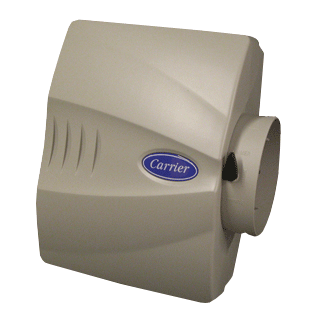
Whole-Home Humidifiers for Winter Humidity Control
Humidifiers add moisture to dry indoor air and help maintain a more comfortable relative humidity level during the heating season. Whole-home models connect to a central HVAC system and distribute moisture through the ductwork, avoiding the room-by-room filling and cleaning required by portable units.
For Toronto and GTA homes, the main decision is not simply whether to add humidity, but how much humidification capacity the home needs and which type works best with the HVAC system. Home size, air leakage, heating equipment, duct layout and desired humidity level can all change the required output.
Choosing the Right Whole-Home Humidifier
Whole-home systems differ in how they create and distribute moisture. Bypass, power and steam humidifiers can all address dry winter air, but their capacity, installation requirements and dependence on HVAC operation are different.
Humidification Capacity
A tighter or smaller home may need less moisture than a large or air-leaky property. Capacity should reflect the home's actual moisture loss rather than floor area alone.
HVAC Compatibility
Bypass and power models work with ducted airflow in different ways, while steam provides its own moisture source. The heating and air-distribution system can influence which type performs best.
Available Duct Space
Bypass installations require suitable duct locations and a bypass connection. Limited mechanical-room space can make another configuration more practical.
Winter Moisture Demand
Large homes, high ceilings and substantial outdoor-air infiltration can increase moisture demand enough that a lower-output humidifier struggles to reach the desired setting.
Water and Drainage
Whole-home installation requires a suitable water connection, and flow-through or steam configurations may also require appropriate drainage.
Maintenance
Water panels and steam components have different maintenance requirements. Replacement frequency and water conditions should be considered before selecting by capacity alone.
Bypass vs Power Whole-Home Humidifiers
Bypass and power humidifiers both use water panels to transfer moisture into HVAC airflow, but they move air through the humidifier differently. That distinction affects installation space, moisture output and how strongly the system depends on the duct configuration.
Healthy Climate Bypass Humidifiers
The Healthy Climate whole-home bypass category includes models designed to provide up to 17 gallons of moisture per day. They use furnace or air-handler airflow and a water panel to evaporate moisture into the air distributed through the home.
A bypass model can be an effective choice when adequate supply and return duct space is available. The trade-off is that installation requires a bypass air path, so a crowded mechanical room or unsuitable duct arrangement can make another humidifier type more practical.
Healthy Climate Power Humidifier
The whole-home power humidifier can provide up to 18 gallons of moisture per day and includes its own fan to move air through the water panel. This removes the need for the same supply-to-return bypass duct arrangement used by a bypass model.
The power configuration can therefore be useful where duct layout makes a bypass connection inconvenient or where higher moisture delivery is required. It also requires a 120-volt electrical supply, which should be included when comparing installation scope.
Bypass vs Power vs Steam Humidification
For some homes, the choice extends beyond water-panel humidifiers. Steam systems create moisture independently rather than relying on evaporation from a wetted panel, which can provide greater humidification capacity but changes installation, electrical use and maintenance requirements.
When a Steam Humidifier Makes More Sense
Steam becomes more relevant when the home's moisture demand exceeds what an evaporative system can reliably provide or when HVAC operating conditions are not ideal for bypass humidification. Large homes, high ceilings, significant air leakage and heating systems with lower supply-air temperatures can increase the need for independent moisture generation.
The trade-off is higher installation and operating complexity. Choosing steam simply because it is the higher-capacity technology can add unnecessary cost if a properly sized bypass or power humidifier can maintain the desired winter humidity.
Humidifier Capacity Is Not Determined by Square Footage Alone
Floor area is useful for initial comparison, but two homes of the same size can have very different humidification requirements. Air leakage, ceiling height, ventilation, number of occupants and how often exterior doors open all influence how quickly moisture leaves the home.
A newer, tighter house can often retain moisture more effectively than an older property with substantial air infiltration. Oversimplifying selection to a square-foot rating can therefore result in either insufficient output or unnecessary capacity.
Why a Humidifier May Struggle to Reach the Set Humidity
Installing a larger humidifier does not always solve low indoor humidity. The home can lose moisture faster than the equipment adds it, particularly during very cold weather when outdoor air is extremely dry after being heated indoors.
The Humidifier Runs but the Home Stays Too Dry
A humidifier is selected without considering air leakage, HVAC runtime or actual moisture demand. During a cold Toronto winter, dry outdoor air continually enters the house and the humidifier cannot replace moisture quickly enough to reach the desired setting.
Whole-Home Humidifier vs Portable Humidifier
A portable humidifier can be practical when moisture is needed in one bedroom, office or other limited area. A whole-home system is designed for centralized humidity control across the spaces served by a ducted HVAC system.
Portable units require manual filling and regular cleaning, while a properly installed whole-home unit uses a permanent water connection and automatic humidity control. Whole-home installation costs more initially, but it avoids operating several separate room units when the goal is consistent humidity throughout the house.
Whole-Home Humidifiers and Furnace Operation
Evaporative humidifiers depend on HVAC airflow to carry moisture through the duct system. Their actual output can therefore be affected by furnace runtime, airflow and supply-air conditions rather than the humidifier's rated capacity alone.
This becomes important when replacing a conventional furnace with different heating equipment. A humidifier that performed adequately with long periods of warm furnace airflow may behave differently when operating conditions change, so compatibility should be reviewed during HVAC replacement.
Humidifiers With Heat Pumps
A ducted heat pump can operate with lower supply-air temperatures than a traditional gas furnace, which can reduce the evaporation potential of some bypass configurations. That does not automatically rule out whole-home humidification, but it changes the system-selection discussion.
Power or steam humidification may be worth evaluating when a heat-pump system cannot provide the conditions needed for adequate bypass output. The decision should reflect the specific air handler, airflow and moisture load rather than heating technology alone.
Humidity Control During Toronto Winters
Toronto's heating season can produce very dry indoor conditions because cold outdoor air contains relatively little moisture. Once that air enters the home and is heated, its relative humidity drops, increasing the need for controlled humidification.
The appropriate indoor setting is not necessarily constant throughout winter. During very cold weather, excessive indoor humidity can create condensation on windows and other cold surfaces, so humidity control should account for outdoor conditions and the home's envelope.
More Humidity Is Not Always Better
The purpose of a humidifier is controlled moisture, not maximum moisture. Raising indoor humidity beyond what the building envelope can tolerate can create condensation on windows or other cold surfaces.
Older Toronto homes with less efficient windows may need a lower winter humidity setting than newer homes with higher-performance glazing. A humidistat setting should therefore respond to the home's actual condensation behaviour rather than one fixed percentage for every property.
Avoid Window Condensation From Excess Humidity
Window condensation is an important practical signal when adjusting a whole-home humidifier. If moisture repeatedly collects on cold glass, indoor humidity may be too high for the outdoor temperature and window performance.
The Humidifier Is Set Too High During a Cold Snap
Indoor humidity remains at a setting that was comfortable during milder weather even as outdoor temperature falls sharply. Moisture begins condensing on colder windows and surfaces, indicating that the humidity setting should be reduced for the conditions.
Automatic vs Manual Humidity Control
A manual humidistat maintains the selected indoor setting until someone changes it. Automatic control can adjust the target in response to outdoor conditions, helping reduce the risk of excessive humidity as exterior temperatures fall.
Manual control can work well when homeowners actively monitor indoor conditions, while automatic control reduces seasonal adjustment. Control strategy should be considered alongside the humidifier itself because even properly sized equipment can create poor results if the humidity target is inappropriate.
Humidifier Installation Requirements
A whole-home humidifier installation normally requires a suitable duct location, water supply, control wiring and drainage arrangement. Power and steam systems can add electrical requirements that should be considered before the equipment location is finalized.
Mechanical-room layout matters. A humidifier that technically fits on the duct should still leave adequate access to the furnace, air conditioner coil, filter and other components that require future service.
Supply Duct vs Return Duct Installation
Installation location depends on humidifier type and duct configuration. Bypass systems use pressure differences between supply and return air, while power models use an integrated fan and do not need the same bypass-air arrangement.
The easiest open section of duct is not automatically the correct mounting location. Airflow direction, available clearance, bypass routing, water access and serviceability all need to be considered together.
Replacing an Existing Furnace Humidifier
An older whole-home humidifier can often be replaced without redesigning the entire HVAC system, but the existing opening and connections should not automatically determine the new model. Replacement is an opportunity to check whether the old humidifier was actually providing enough moisture.
If the previous system struggled throughout winter, installing an equivalent-capacity replacement may reproduce the same limitation. Home renovations, new windows, HVAC changes and additions can also alter the moisture load since the original installation.
Replacing a Humidifier During a Furnace or Heat Pump Upgrade
Heating-system replacement is a useful time to reassess humidification because ductwork and equipment are already being modified. The new system may have different airflow, supply temperatures or controls that change how an existing humidifier performs.
Reusing an old unit can reduce immediate cost when it remains compatible and serviceable, while replacing it during the HVAC project can simplify duct modifications and control integration. Condition and compatibility should guide the decision rather than age alone.
Whole-Home Humidifier Installation Cost
Installed cost varies by humidifier type and the amount of work required around the HVAC system. Bypass units generally involve the simplest equipment, power models add an integrated fan and electrical requirement, and steam systems typically require the most extensive electrical and water-management work.
Water-line distance, drainage, duct modifications, controls and mechanical-room access can all change the final cost. Comparing equipment price without installation scope can therefore make two very different projects appear equivalent.
Water Panels and Humidifier Maintenance
Bypass and power humidifiers use replaceable water panels that should be inspected regularly and typically replaced as part of annual maintenance. Mineral accumulation can reduce water distribution and evaporation, lowering humidification performance even when the fan and controls continue to operate.
Water conditions influence how quickly deposits develop. If an older humidifier appears to be running but humidity remains low, checking the water panel, water flow and control operation can be more appropriate than immediately assuming the unit is undersized.
Steam Humidifier Maintenance
Steam systems use a different moisture-generation process and therefore have different service requirements from water-panel humidifiers. Mineral accumulation and steam-generation components need periodic attention to maintain output.
The higher capacity of steam does not eliminate maintenance. Homes with challenging water conditions should consider ongoing service requirements when comparing steam with simpler evaporative equipment.
Humidifier vs HRV or ERV
A humidifier adds moisture to indoor air, while a heat-recovery or energy-recovery ventilator exchanges stale indoor air with outdoor air. They solve different indoor air quality problems and should not be treated as interchangeable equipment.
Ventilation can influence the home's humidity load because outdoor air introduced during winter is typically dry once heated. If ventilation rates are high, humidifier sizing should account for that additional moisture loss rather than treating the humidifier independently.
Humidifier vs Dehumidifier
A humidifier addresses air that is too dry, while a dehumidifier removes excess moisture. Toronto homes can potentially need humidification during winter and dehumidification during warmer, more humid periods.
The correct equipment should follow measured indoor conditions. Installing a humidifier to solve a problem caused by something other than low relative humidity will not address the underlying issue.
Whole-Home Humidifier Selection Checklist
Choose a whole-home humidifier by matching moisture output and operating method to the home and HVAC system. The checklist below helps separate capacity requirements from installation and maintenance considerations.
Choose the Right Whole-Home Humidifier
- Confirm that low indoor humidity is the problem before selecting humidification equipment.
- Consider home size, ceiling height, air leakage and ventilation rather than square footage alone.
- Compare bypass, power and steam humidification by actual moisture demand.
- Check whether the HVAC system provides suitable airflow and operating conditions for an evaporative humidifier.
- Evaluate power or steam options when bypass capacity or duct configuration is unsuitable.
- Confirm adequate duct space before choosing a bypass configuration.
- Review water-supply and drainage requirements at the proposed installation location.
- Verify electrical requirements for power or steam equipment.
- Choose a humidity-control strategy that can respond to changing Toronto winter conditions.
- Reduce the humidity target if persistent window condensation develops during colder weather.
- Review compatibility when replacing a furnace or adding a heat pump.
- Inspect an existing humidifier's water panel and water flow before assuming low output means replacement is required.
- Plan for annual water-panel inspection or the applicable steam-system maintenance.
- Keep adequate service clearance around the humidifier and other HVAC equipment.
- Compare complete installed and maintenance costs rather than equipment price alone.
Choosing a Humidifier for Toronto and the GTA
Whole-home humidifiers are most useful when winter dryness affects multiple rooms and the home has a compatible central ducted HVAC system. Bypass models offer straightforward evaporative humidification, power models add their own fan and slightly greater moisture output, while steam is better suited to applications requiring more independent or higher-capacity humidification.
For Toronto and GTA homes, system selection should balance winter moisture demand with the building envelope, HVAC configuration and risk of condensation during very cold weather. Proper sizing and humidity control matter more than simply choosing the humidifier with the highest rated output.
FREE In-Home Estimate