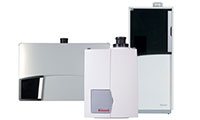


RHS Models
Showing all 3 results
-

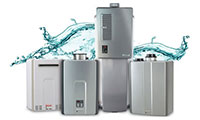
Rinnai RHS19980HEiN Hybrid Tankless Water Heater
-
Rinnai RHS19980HEiP Hybrid Tankless Water Heater
-
Rinnai RHS19980HEXiN Hybrid Tankless Water Heater
RHS Models for Hybrid Residential Water Heating
RHS models combine tankless water heating with a storage-based system to serve residential hot-water demand. Choosing a configuration requires evaluating peak draw, recovery, controls and floor space as a complete assembly.
Choose the system around the draw pattern
A hybrid assembly may suit concentrated demand, but storage volume alone does not describe performance. Compare these requirements together.
Peak draw
Identify overlapping showers, baths and appliance use. Stored water and heating recovery work together, so both must suit the required delivery temperature.
Assembly fit
Check tank, heater, pump and pipe clearances. The space required for maintenance can be greater than the apparent equipment footprint.
Fuel and controls
Verify the complete RHS code and fuel version. Pump and controller arrangements must belong to the selected assembly, not an approximately similar hybrid system.
Verify residential model identity
RHS documentation identifies a residential hybrid system, while similarly named CHS and Demand Duo assemblies can describe other configurations. Confirm the actual supplied package rather than interpreting the catalogue label as a universal specification.
The listed RHS19980HE variants need model-specific review. Do not assume a later H-Series manual applies, or that a storage figure expressed in one gallon convention can be compared directly with another.
Replacement costs include the supporting work
For a Toronto or GTA installation, review approved venting, condensate requirements, gas capacity, electrical supply and water connections. Identify how the tank and heating components can be removed in future.
Ask whether the quote includes the pump, controls, valves, commissioning and any water-treatment provisions. Keeping old piping can reduce work only when it is suitable for the replacement. A hybrid system should be compared with alternatives using usable delivery and recovery requirements, not a promise of unlimited simultaneous flow.
Request an assembly-specific proposal
Bring the existing system information and household demand profile. Resolve these details before ordering a replacement.
RHS selection checklist
- Confirm residential assembly and complete model code.
- Compare storage and recovery at the required temperature.
- Verify tank, pump and controller inclusion.
- Review venting and condensate arrangements.
- Check gas, power and water connections.
- Include access, startup and maintenance requirements.
Choose an RHS system after confirming the exact assembly and its current availability. A coordinated installation scope makes comparison with other residential water-heating options more useful.
FREE In-Home Estimate