
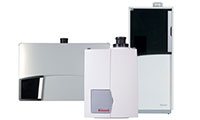


RUC Models
Showing all 6 results
-

Rinnai RUC80iN Super High Efficiency Plus Tankless Water Heater
-

Rinnai RUC80iP Super High Efficiency Plus Tankless Water Heater
-

Rinnai RUC90iN Super High Efficiency Plus Tankless Water Heater
-

Rinnai RUC90iP Super High Efficiency Plus Tankless Water Heater
-

Rinnai RUC98iN Super High Efficiency Plus Tankless Water Heater
-

Rinnai RUC98iP Super High Efficiency Plus Tankless Water Heater
RUC Models for Indoor Condensing Water Heating
RUC models are indoor gas-fired condensing tankless water heaters. The listed RUC80, RUC90 and RUC98 variants should be compared using complete fuel-specific model numbers, required hot-water delivery and an approved indoor installation plan.
Choose capacity and venting together
A larger unit is useful only when the household demand and site can support it. Compare these conditions before selecting a model.
Required flow
Assess overlapping fixtures at the required temperature rise. Colder Toronto inlet water means the maximum headline flow cannot be used as a year-round delivery promise.
Approved vent system
RUC installations can have model-specific venting options. Confirm the complete permitted arrangement, including termination and length limits, before reusing a vent.
Fuel supply
Natural-gas and propane variants need the appropriate supply and appliance specification. Similar input ratings do not establish interchangeable fuel configurations.
Compare RUC with recirculation-equipped alternatives
A condensing heat exchanger does not itself provide a complete recirculation system. If faster delivery at distant fixtures is the goal, identify the compatible pump, controls and return path separately.
These are older product-family listings. Confirm current Canadian availability, service support and replacement options without assigning later SENSEI, RX or RXP functions to the proposed RUC unit.
Assess the whole indoor replacement
Review gas capacity, electrical provision, water connections, condensate handling and required service clearances. A tank-to-tankless conversion can change both the utility requirements and the maintenance arrangements.
For GTA homes, ask for removal, vent changes, isolation valves and startup checks in the installed quote. Existing pipes and vent components should be retained only after compatibility is verified. Consider water quality and descaling access before placing the appliance behind cabinetry or in a confined mechanical area.
Confirm the complete RUC installation
Bring the old equipment details and a fixture list. These checks make a capacity and cost comparison more reliable.
RUC model selection checklist
- Verify full model, generation and fuel code.
- Compare flow at winter temperature rise.
- Check approved vent components and routing.
- Identify any required recirculation hardware.
- Plan condensate and service-valve access.
- Include utility changes and commissioning.
Choose an RUC model after verifying demand, site fit and current supply. Compare replacement alternatives using the same installation requirements.
FREE In-Home Estimate